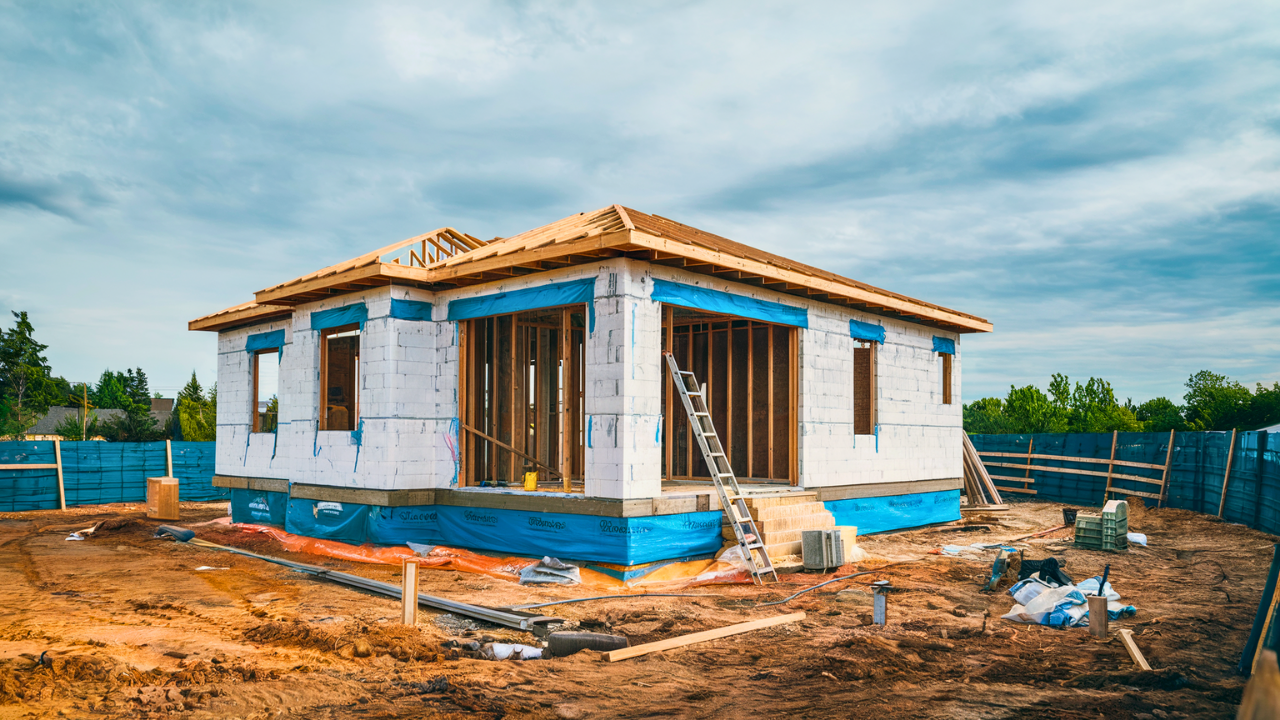
Site Inspections annotated survey plan of the deck showing measured dimensions and photographic callouts to defective connections
Court Cases
Case file · Dandenong Magistrates' Court

Unregistered builder fined $70,000 over a dangerous deck

A homeowner in Belgrave put up a Facebook post asking about work on a carport and pergola. The man who answered was not a registered builder, told her no building permit was needed, and asked for a deposit ten times the legal maximum. She paid $43,000. The council later confirmed the decking was dangerous and should not be used. Site Inspections wrote the independent inspection report in this matter, and we referred it to the regulator.

Published: 14 August 2026
Where: Dandenong Magistrates' Court, Victoria
Read time: ~22 min
Editor's note
Site Inspections is not a neutral bystander in this matter and we say so at the top. We were engaged by the homeowner and we prepared the independent inspection report referred to in the Commission's published account of the case. We also referred the matter to the regulator. That referral is our own first-hand account and does not appear on any public record. Everything stated here about the prosecution comes from the Building and Plumbing Commission's published media release of 30 March 2026, concerning a concluded prosecution in which the defendant was found guilty and convictions were recorded. Our inspection findings are our own documented observations, made on one property on one day in March 2023 and measured against named standards. They are not findings of any court. The homeowner is not named and no address appears in this article, in any image, in any caption or in any alt text. The Commission did not name her. Neither did the newspaper that reported the hearing. Neither do we.
Key facts
Who
Joshua Mionnet
33, of Officer. A sole trader
Trading as
Constructed Building Group
Not registered Neither the business name nor the individual appeared on the register of practitioners when we searched it in March 2023
Charges
4
Found guilty on all four. Unregistered building work, unregistered plumbing work, no building permit, no domestic building insurance
Fine
$70,000
Magistrate Hugh Radford, Dandenong Magistrates' Court
VCAT order
$55,000
Never paid Damages ordered in the homeowner's favour. The Commission records that it has never been paid
Our inspection
7 March 2023
Two inspectors. A 48 page report carrying 114 images, with thermal imaging
The prosecution facts stated here are drawn from the Building and Plumbing Commission's published media release of 30 March 2026. The inspection facts are drawn from the report Site Inspections prepared for the homeowner on 7 March 2023. General information only, not legal advice.
Key takeaways
He was found guilty of four charges, convicted and fined $70,000 at the Dandenong Magistrates' Court. Unregistered building work, unregistered plumbing work, no building permit, and no domestic building insurance.
He asked for a 50 per cent deposit. Section 11 of the Domestic Building Contracts Act 1995 caps a deposit at 5 per cent where the contract price is $20,000 or more. On a $35,000 quote that is $1,750, not $17,500.
He told her a building permit was not required. It was. A deck or verandah attached to a house needs one whatever its size, and the permit is what would have brought an independent building surveyor to the site.
Our report recorded 18 items on that work: 14 non-compliant and 4 safety hazards. It recommended the deck be demolished. Yarra Ranges Council later confirmed the decking was dangerous and should not be used.
The fine is not compensation. The $70,000 penalty is payable to the state. The $55,000 VCAT ordered him to pay the homeowner has never been paid. A conviction and a recovery are two different things.

01What the court decided

Four charges, found guilty on all of them, convicted and fined $70,000. And a separate order for damages that has still not been paid.

Joshua Mionnet, 33, of Officer, was convicted and fined $70,000 at the Dandenong Magistrates' Court after being found guilty of four charges relating to unregistered building and plumbing work at a Belgrave home. The Building and Plumbing Commission published the outcome on 30 March 2026.

4
Charges
Found guilty on all four
$70,000
Fine
Payable to the state, not to the homeowner
$55,000
VCAT damages
Ordered in her favour. Never paid
Building and Plumbing Commission media release30 MARCH 2026
“Mionnet, 33 of Officer, was convicted and fined $70,000 after being found guilty of 4 charges relating to unregistered building and plumbing work at a Belgrave home.”
Quoted verbatim. This is a concluded prosecution in which the defendant was found guilty and convictions were recorded. Nothing in this article is an allegation.

The Commission's account sets out what the offending covered. Each limb of it is a separate protection, and each one failed independently of the others.

Building and Plumbing Commission media release30 MARCH 2026
“The offences included carrying out building and plumbing work without the required accreditation, and carrying out building work without a permit and without the required domestic building insurance (DBI).”
Quoted verbatim from the Commission's release. The release describes the offences collectively rather than listing four separately numbered charges, and it does not name the sections charged. The statutory provisions quoted later in this article are set out as the rules that govern this work, not as the charge sheet.
What the offences covered
What that protection is for
Building work without the required accreditation
Registration is the check that somebody has the qualifications, the experience and a regulatory history you can look up. It is also what makes them answerable to a regulator afterwards.
Plumbing work without the required accreditation
Plumbing is separately licensed for a reason. Roof drainage, downpipes and stormwater are plumbing work, and they are where water gets into a building when they are wrong.
Building work without a permit
A permit brings an independent building surveyor to the job, with mandatory inspections at set stages. It is the only stranger who ever looks at the work while it can still be seen.
Building work without the required domestic building insurance
Insurance is what stands behind the job when the builder will not or cannot put it right. Where no policy was ever taken out for the work, there is nothing there to respond.

On the sentence, the Commission records that Magistrate Hugh Radford said the offending “was very serious and required a substantial penalty as a punishment and deterrent”. That is the Commission's account of the hearing rather than a transcript of the bench, and we treat it as such.

“This court outcome should serve as a warning to those who illegally build and put consumers at risk.”

Anna Cronin, Commissioner and Chief Executive Officer
Building and Plumbing Commission media release, 30 March 2026. The Commissioner also said: “The BPC is working hard to hold unregistered builders to account but the best way to stop them is not to hire them in the first place.”

Decided, and still outstanding

This is the distinction that matters most to anybody reading this while something similar is happening to them. A conviction and a recovery are two different events, and only one of them has happened here.

What happened
Status
Where the money goes
Convicted and fined $70,000 on four charges, Dandenong Magistrates' Court
Decided
A fine is a penalty. It is payable to the state and it does not go to the homeowner.
Ordered by VCAT to pay $55,000 in damages to the homeowner
Unpaid
The Commission records that the order has never been paid. She has the order. She does not have the money.
$43,000 handed over against a $35,000 quote, on work left incomplete and defective
Not recovered
Nothing in the public record indicates that any of it has come back.

We are being deliberate about that middle row. It would be easy to read a $70,000 fine as the story ending well. The penalty and the loss are separate ledgers, and on the ledger that mattered to her the balance has not moved.

What it cost her

The Commission opens its account by describing an illegal and dangerous renovation “that left a single mum financially and emotionally devastated”. Court reporting of the hearing records that the money she paid had been given to her by her late father, and that she gave a victim impact statement about what the experience had cost her beyond the money: her peace, her confidence, and ongoing distress for her and her family. She wrote that she had lost her “sense of trust”, in tradespeople, in the system and in her own judgement, and that she now felt “guarded and fearful of being taken advantage of again”.

The costs did not stop at what she paid him. Court reporting of the hearing records that she then paid more than $13,600 for independent inspection and reporting, which is what established that the incomplete work was defective. Site Inspections carried out that inspection and wrote that report. We are disclosing that because a reader is entitled to know that the firm telling this story was paid to work on it. What the figure covers is the professional investigation of a build that had already gone wrong, and it sits on top of the $43,000 she had handed over and the $55,000 she has never seen.

We have quoted that briefly and we are not going to build a story around it. She is the reason this article exists, not an illustration in it. The rest of it is about the mechanism, because the mechanism is the part that can be handed to somebody else before it happens to them.

02He asked for a 50 per cent deposit. The legal maximum is 5 per cent.

One number, checkable in ten seconds, and it was wrong by a factor of ten before any work started. If you take one thing from this article, take this.

The Commission's account is that Mionnet quoted $35,000 for the job and then “asked for a 50% deposit”, which the Commission describes as “well in excess of the maximum 5%”. It records that he “continually asked for progress payments and added extra charges that were not included in the original quote”. In total the homeowner handed over $43,000.

The maximum is not a guideline or an industry convention. It is a provision of an Act of the Victorian Parliament, it carries a penalty, and it has read the same way for years.

“A builder must not demand or receive a deposit under a domestic building contract of more than 5% of any contract price that is $20 000 or more…”

Domestic Building Contracts Act 1995 (Vic), section 11(1)(a)
Act number 91/1995. Quoted from the authorised version. The same words appear in the version that was in force when this work was quoted.
Domestic Building Contracts Act 1995 (Vic)S 11(1)
“A builder must not demand or receive a deposit under a domestic building contract of more than
(a) 5% of any contract price that is $20 000 or more;
(b) 10% of any contract price that is less than $20 000
before starting any work under the contract.

100 penalty units.”
Quoted from the authorised version, with the Act's paragraph dashes set as line breaks and nothing else changed. Note the two words demand or receive: the offence is committed by the asking, not only by the taking. And note the tail, before starting any work under the contract. The cap is on what can be collected up front, which is exactly the money a homeowner has no way of getting back if nobody ever turns up.

Run the arithmetic on the quote in this matter. It takes seconds and it is the whole point.

$1,750
The maximum lawful deposit
5 per cent of the $35,000 quoted
$17,500
What 50 per cent comes to
Ten times the lawful figure
$8,000
Paid above the quoted price
$43,000 handed over against a $35,000 quote

There is a second provision that speaks directly to that last figure, and almost nobody knows it exists.

Domestic Building Contracts Act 1995 (Vic)S 16(1)
“A builder who enters into a domestic building contract must not demand, recover or retain from the building owner an amount of money under the contract in excess of the contract price unless authorised to do so by this Act.

100 penalty units.”
A contract price can move lawfully. Variations, prime cost items and provisional sums are the authorised routes, and each has its own requirements about being agreed and documented. What the section prohibits is money asked for outside those routes. “Extra charges that were not included in the original quote” is precisely the language the section is written against.

Two things have to be said plainly here so that nobody misreads this section. Mionnet was not charged under either of those provisions. The four charges the Commission describes are about registration, permits and insurance. We set out sections 11 and 16 because they are the rule the deposit demand fell outside, and because they are a rule a reader can apply to their own quote this afternoon.

Domestic Building Contracts Act 1995 (Vic)S 11(3) & 11(5)
“If a builder does not comply with subsection (1), the building owner may avoid the contract at any time before it is completed.”

“If a court finds proven a charge under subsection (1) against a builder, it may order the builder to refund to the building owner some or all of the amount the building owner has paid the builder under the contract.”
This is unusual and worth knowing. An excessive deposit is one of the few building matters where the criminal court hearing the charge has a power to order money back, on top of any penalty it imposes. Whether that power is available in a given case depends on what is charged, which is a question for a lawyer and not for us.
The deposit is the earliest signal you will ever get
A deposit demand arrives before any work, before any relationship, and before any money is at risk. It is the one moment in the whole job when walking away costs nothing. An unregistered person cannot lawfully hold the contract, cannot obtain the insurance and often has no intention of applying for the permit, and the deposit is where all of that surfaces first, in a single number you can check against a single sentence of an Act. More than 5 per cent on a job of $20,000 or more is not a negotiating position. It is an offence.

03"You don't need a permit for this"

The second thing he told her, and the one that removed every independent set of eyes from the job.

Building and Plumbing Commission media release30 MARCH 2026
“The Dandenong Magistrates' Court heard Mionnet quoted $35,000 for the job, and told the homeowner a building permit was not required.”

A permit was required. The general rule is a single sentence, and it is not addressed to builders only.

Building Act 1993 (Vic)S 16(1) & 16(3)
“A person must not carry out building work unless a building permit in relation to the work has been issued and is in force under this Act.”

An owner of land must ensure in relation to building work carried out on that land that a building permit in relation to the work has been issued and is in force under this Act.”

Each carries a penalty of 500 penalty units, in the case of a natural person, and 2500 penalty units, in the case of a body corporate.
Subsection (3) is the one to sit with. The obligation to make sure a permit exists sits on the owner of the land as well as on the person doing the work. That is not a criticism of anybody who was told otherwise by a person they were paying to know. It is the reason you cannot safely take a tradesperson's word for it: if they are wrong, the exposure lands on your title.

There is no size exemption hiding here either. The regulator's own practice note on when a permit is required, which our report quotes, deals with decks and verandahs directly.

Building Practice Note BP-01, When is a building permit requiredDECKS & VERANDAHS
“A building permit is required for decks and verandahs that are attached to a building such as a house or swimming pool, irrespective of size. A building permit is required for detached decks as part of the amenity to a building.”
Quoted as reproduced in the Site Inspections report of 7 March 2023, which set the practice note out in full alongside the finding. Practice notes are guidance published by the regulator and are revised from time to time; the statutory requirement is section 16 of the Building Act 1993.

The structure in question was a covered entertaining area attached to the back of the house, with a carport alongside it. Our report's site drawing shows the work marked against the floor plan.
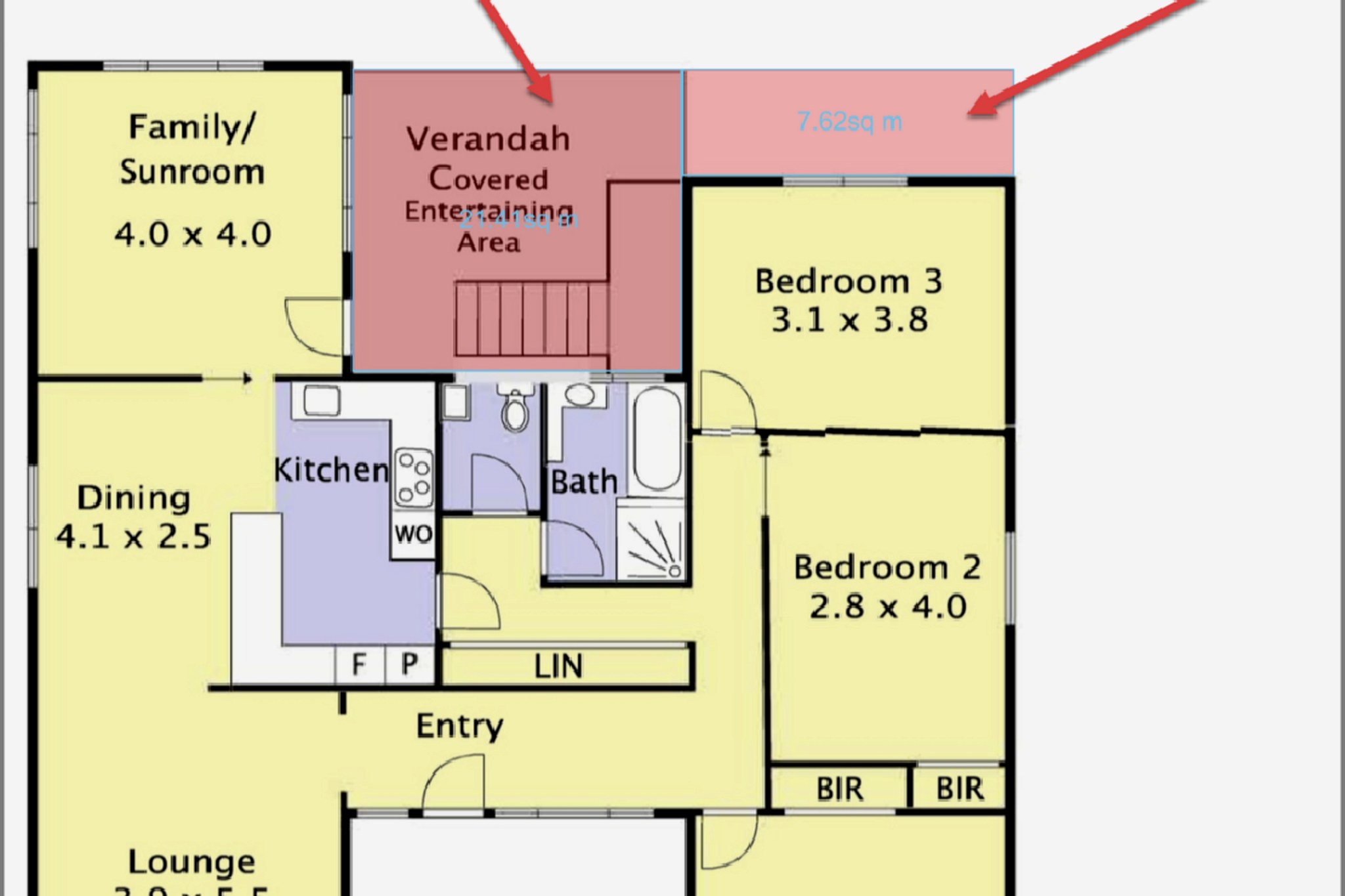
Floor plan of a single storey house from a Site Inspections report, with the covered entertaining area and verandah at the rear shaded in red and marked with arrows to show the extent of the works inspected
The works area. Floor plan from the Site Inspections report of 7 March 2023, with the covered entertaining area and the adjoining verandah shaded to show the extent of the work inspected. Room labels are as they appear on the plan. No address or owner detail appears on this drawing.

Our report recorded the permit breach as a safety hazard rather than a paperwork failure, and the reason is in the sequence rather than the form. A building permit does not merely authorise work. It appoints a registered building surveyor to the job, it fixes the mandatory inspection stages, and it ends in a certificate of final inspection or an occupancy permit. Footings get looked at before they are covered. Framing gets looked at before it is clad. Connections get looked at while they are still connections rather than a ceiling.

Take the permit away and none of those inspections happen, and nobody outside the transaction ever sees the work at the only moment it can be seen. That is the practical difference between a deck that is unapproved and a deck that is unsafe, and in this matter it was both.

04What our inspection actually found

Two inspectors attended on 7 March 2023, engaged by the homeowner. This is what the report recorded, item by item, against the standard each item engages.

The inspection was carried out by two Site Inspections building consultants on a single storey house on a gently sloping block, occupied at the time, in clear and dry conditions. It was non-invasive, which means nothing was opened up. Everything recorded below was visible to anybody who went and looked. The tool list included a FLIR E85 thermal imaging camera, a digital vernier caliper, tape measures and a probe. The report ran to 48 pages and carried 114 images.

14
Items recorded non-compliant
4
Recorded as safety hazards
48
Pages
114
Images

The four we recorded as safety hazards

Fourteen items were recorded as non-compliant. Four were recorded a level above that, as safety hazards, and those four are the ones that describe a structure people were expected to stand on.

Safety hazard
What the report recorded
Breach of the building regulations
Recorded against the permit finding: “This balcony is unsafe to be walked on or under and must be totally demolished.” The report also recorded the carport as structurally unsafe.
No barrier to prevent falls
“An inspection of the verandah found that a barrier was NOT INSTALLED.” A continuous barrier is required where it is possible to fall 1 m or more from a trafficable surface.
Floor bearers
“240x45 MGP10 floor bearers all fail in strength and serviceability checks. In particular, the bearer in the middle of the deck spanning 4.17m and supporting the perpendicular floor bearers is significantly overstressed.”
Single bolt connections
“Bolted connections with 1 bolt is not acceptable. A minimum of 2 bolts is required for all connections with bolt spacing and edge distance as per AS1720.1 Clause 4.4.4.3.”

The report's recommendation on the bearers was not a repair. It was “DEMOLISH WORKS, AND FULL STRUCTURAL ENGINEERING DOCUMENTATION IS REQUIRED”. That is a strong recommendation to put in writing to a client who has just paid $43,000, and it is not one anybody makes casually.

The connections, which are where a deck actually fails

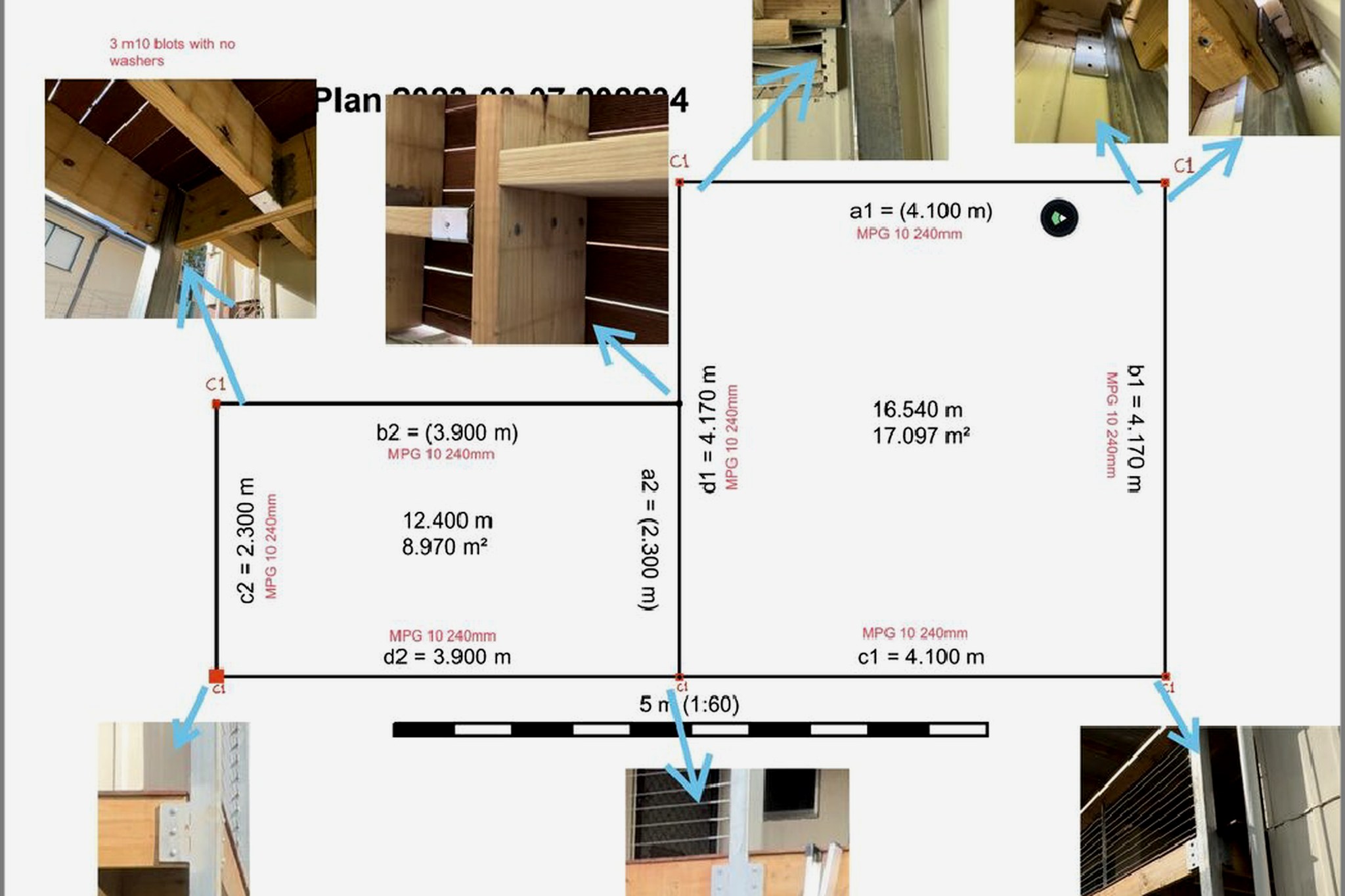
People look at a deck and see timber. What holds a deck up is not the timber, it is the connections between the pieces, and a connection can be wrong in ways that leave the timber looking perfect. That is the argument the annotated survey below is making. Almost every callout on it is a connection.

Annotated site survey drawing from a Site Inspections report showing the two bays of a deck with bearer spans of 4.170 metres and 2.300 metres marked and labelled MGP10 240 millimetre, surrounded by photographs of the framing connections with arrows linking each photograph to its location, and a note recording three M10 bolts installed with no washers
The survey. Site Inspections drawing from the report of 7 March 2023. Each photograph is tied by an arrow to the connection it was taken at. The spans and the bearer size are marked on the plan, including the 4.170 metre span the report records as significantly overstressed, and the annotation at top left records three M10 bolts installed with no washers. No address or owner detail appears on this drawing.

Four separate connection findings were recorded, and they compound rather than sit side by side.

Site Inspections report, Framing: Steel and Connections7 MARCH 2023
Washers: “An inspection of the washers installed found that they were MISSING.”

Coach screws: “Coach screw connection into the end grain of the timber member reduces the connection strength to 60% of its capacity… this type of connection is not advised due to possible splitting of the timber and a steel angle bracket with a bolted connection into the side grain should be installed.”

Main beam: “Nail connection from the main beam to the bearers is not adequate. This should have been connected to the column with a cleat plate connection or to a beam with a steel angle and bolted connection. Essentially, none of the deck framing (apart from the joists) is structurally adequate and should be designed by a structural engineer or installed in accordance with AS1684.”
Assessed against AS 1720.1 clauses 4.4.4.3, 4.4.5 and 4.5.2.1, and AS 1684.2 clauses 9.2.3 and 9.2.4. A washer is not a finishing detail: without one, the bolt head bears on a small area of timber and crushes into it, and the joint loosens under exactly the loads it exists to carry.

The steel column connections were the fourth. The report recorded that the columns were missing connections and overhanging their pads, that the steel plates had not been welded to the columns, and that the columns were not fully supported by the concrete pads beneath them. It also recorded that the depth of those pad footings was unknown and could not be established without excavation, and recommended that an engineer or the relevant building surveyor dig and inspect them.

The full schedule

Eighteen items in total. Each one is tied to the standard it engages, which is what makes a report something a council, a regulator, an insurer or a tribunal can act on rather than a list of opinions.

What we recorded
Standard engaged
Recorded as
Roof pitch below the minimum for the sheet profile. The report records a minimum of 5 degrees
NCC 2019, cl 3.5.1.3
Non-compliant
Screw fixings to the carport sheet roofing not adequate. Recommendation: increase the number of fasteners
NCC 2019, cl 3.5.1.5
Non-compliant
Roof batten installation not adequate
NCC 2019, cl 3.5.1.4
Non-compliant
Downpipe discharging outside its dedicated drain, close to the house, where water can undermine footings
AS/NZS 3500.3, cl 3.7.8
Non-compliant
External PVC pipework unprotected from direct sunlight
AS/NZS 3500.3:2018, cl 2.3.2
Non-compliant
Carport gutter without adequate fall. A minimum fall of 1:500 applies to eaves gutters
SA HB 39:2015; NCC 2019, cl 3.5.3.4
Non-compliant
Roof water spreader discharging where it should not
SA HB 39:2015, cl 5.7.7
Non-compliant
Flashings left incomplete. The report records: water will enter the building, causing deterioration of building elements
NCC 2019, cl 3.10.6.3 and P2.2.2
Non-compliant
No permits applied for on structural building work
Building Act 1993, s 16; Practice Note BP-01
Safety hazard
Work over $10,000 carried out by a trade not on the register. Neither the business name nor the individual appeared on it
Building Act 1993, s 169F
Non-compliant
No barrier installed to the verandah where a fall of 1 m or more was possible
NCC 2019, cl 3.9.2.2
Safety hazard
No bracing visible to a deck more than 1 m off the ground
NCC 2019, cl 3.10.6.4
Non-compliant
240 x 45 MGP10 floor bearers failing strength and serviceability checks, the 4.17 m centre bearer significantly overstressed
Structural strength and serviceability assessment; AS 1684.2
Safety hazard
Bolted connections made with a single bolt where a minimum of two is required
AS 1720.1, cl 4.4.4.3; AS 1684.2, cl 9.2.4
Safety hazard
Steel washers missing from bolted connections
AS 1720.1, cl 4.4.5; AS 1684.2, cl 9.2.3
Non-compliant
Coach screws driven into end grain, reducing the connection to 60 per cent of capacity
AS 1720.1, cl 4.5.2.1
Non-compliant
Main beam to bearer connection made with nails rather than a cleat plate or a bolted steel angle
AS 1684
Non-compliant
Steel column connections missing and overhanging their pads, plates not welded, footing depth unknown
NCC 2019, cl 3.2.2.3
Non-compliant
How to read that table
The findings were assessed against the National Construction Code 2019 and the Australian Standards in force at the date of the inspection in March 2023. The Code has been amended since, and the Guide to Standards and Tolerances has been replaced. The clause numbers above are the ones that applied to that work on that day. These are our documented observations on one property. They were not tested in the prosecution and they are not findings of any court or regulator.

05The deck the council said should not be used

Two organisations with no connection to each other looked at the same structure and reached the same conclusion.

Our report, written for the homeowner, recommended demolition. The council inspected the site and reached the same conclusion.

Building and Plumbing Commission media release30 MARCH 2026
“In total, the homeowner handed over $43,000 before paying for an independent inspection report which revealed the incomplete work was defective. Yarra Ranges Council also inspected the site and confirmed the decking was dangerous and should not be used.
The independent inspection report referred to in that passage is ours. We disclose that at the top of this article and we repeat it here rather than let a reader discover it late.

The carport was in the same condition as the deck. The report recorded that it was structurally unsafe because of inadequate fixing into the concrete pads, that the steel plates had not been welded to the steel columns, and that the columns were not being fully supported by the pads they stood on.

What "dangerous" means on a deck

The word does a lot of work in a media release and almost none in a person's head, so it is worth being concrete about it. Put the findings together and this is what the structure was.

A raised deck, more than a metre off the ground, with no bracing, which is what stops a raised platform racking sideways under load. No barrier along the edge, where a fall of a metre or more was possible. Bearers that failed their strength and serviceability checks, with the central one carrying the others across a 4.17 metre span described in the report as significantly overstressed. The main beam nailed to the bearers instead of bolted through a cleat or a steel angle. Bolted joints made with one bolt where two are required, and made without the washers that stop a bolt head crushing into the timber. Steel columns overhanging their footings, on pads of unknown depth.

None of that announces itself. A deck like that holds up a quiet afternoon perfectly well. The load case it fails is the one everybody builds a deck for: a group of people standing in the same place at the same time, which is the moment the connections are asked for more than they were ever capable of. Connection failures also tend not to be gradual. The warning signs people expect, the sag and the creak, come from timber under load, and here the timber is not the part that is failing.

NCC 2019, bracing to decks and balconiesCL 3.10.6.4
“Where a deck or balcony is more than 1 m off the ground when measured from the uppermost surface of the deck or balcony at any point to the top of any supporting footing, bracing must be installed… Two diagonally opposed 30 x 0.8 mm galvanized steel straps must be installed across the top or underside of the joists…”
Quoted as set out in the Site Inspections report of 7 March 2023. Our finding on this item was that no bracing was visible at the time of the inspection.
If you think a structure at your home may be unsafe
Stop using it, and keep people off it and out from under it, which is the instruction our report gave in this matter. Contact your local council, which has building enforcement powers and can inspect. Get the structure assessed by somebody independent who will put the findings in writing against named standards, because a verbal reassurance from whoever built it is worth nothing to a council, an insurer or a court. Do not have it patched before it has been assessed: repairs made over the top of a structural problem hide the evidence and rarely fix the cause.

06Why we referred it to the regulator

Our own account of our own conduct, stated once and without embellishment.

Site Inspections referred this matter to the regulator. That is a statement about what we did, made by us. It is not on any public record and the Commission's release does not mention it, so a reader is entitled to weigh it accordingly.

The reasons were on the face of our own report. It recorded that structural works had been undertaken and were unsafe. It recorded that no permits had been applied for. It recorded that the work was worth more than $10,000 and that neither Constructed Building Group nor the individual appeared on the register of practitioners when we searched it. Those are not matters a homeowner should have to carry alone, and they are not matters an inspection company can do anything about. They belong with the body that has the power to investigate and to prosecute.

The regulator publishes a route for exactly this, and it invites the public to use it.

Building and Plumbing Commission media release30 MARCH 2026
“If you know of an unregistered builder or plumber, you can report them to us via this online tip off form: Report Unregistered Building and Unlicensed Plumbing Work.”

Two things we are not claiming. We do not know what weight our referral or our report carried in the decision to prosecute, and we make no claim about it. Regulators receive information from many directions and their reasoning is their own. And three years passed between our inspection in March 2023 and the conviction in March 2026. Enforcement of this kind is slow, and the person waiting on it is the person who has already paid.

The honest limit is worth stating too, because it shapes what a report can and cannot do for anybody in this position. A report does not get money back. It documents a position so that somebody with power can act on it: a council, a regulator, an insurer, a tribunal. In this matter it did some of that. It did not do the thing she needed most, which was to be made whole, and the $55,000 order still has not been paid.

07The pattern: the second conviction of this kind we have covered

Different people, different suburbs, different amounts. The same doorway in.

In June 2026 the Commission published the outcome of a prosecution in Melbourne's east, where Ha Thi Miki Nguyen pleaded guilty to 12 charges under the Building Act and was fined $170,000. She had been convicted twice for the same method: a court had dealt with her for similar offending in 2022, and three more homeowners found her afterwards through Facebook, where she advertised under two business names and told each of them she was a registered builder.

Set the two files beside each other and the shared mechanism is easy to see.

Belgrave, this matter
Melbourne's east, June 2026
First contact
He answered her Facebook post asking about work on a carport and pergola
All three homeowners made contact through Facebook advertising
The name used
Constructed Building Group, a business name of a sole trader
Two names she advertised under, and two personal names on the record
Registration
Not registered
Not registered
Insurance
Found guilty of carrying out building work without the required domestic building insurance
Pleaded guilty to arranging building work not covered by the required insurance
Outcome
Convicted, fined $70,000. A separate $55,000 VCAT order remains unpaid
Convicted on 12 charges, fined $170,000. Her second conviction of this kind

The common element is not carelessness on anybody's part. It is that a business name does the work a registration number should be doing. Registering a business name is an administrative step available to anyone, and it produces something that looks exactly like a credential: a name, a logo, a page, a quote on a letterhead. Registration as a building practitioner is a different thing entirely, held by a person or a company, recorded on a public register, and attached to a regulatory history.

Nothing in either file suggests the homeowners did anything unreasonable, and in this matter the public record does not say whether any register search was made. It is not a homeowner's job to police the industry. But there is one asymmetry worth naming: the register search takes a minute and costs nothing. Everything after it, including the report we wrote, costs money.

Where a build is already running and something feels wrong, the work needs to be inspected at each stage while framing, connections and membranes are still open. Where a dispute is already heading to a tribunal, what changes the outcome is an independent expert report that ties each defect to the clause it engages.

08How to check a builder before you pay anyone

Five checks. None of them costs anything, and all of them happen before money moves. The full check, for every state and territory, is here: how to check a builder is registered.

The Commission's own guidance from this case is the shortest version: “consumers should always use a registered builder and a licensed or registered plumber”, and it publishes a free register for both at bpc.vic.gov.au/check.

The threshold that decides whether registration is required is not a rule of thumb. It is a figure fixed by regulation.

Domestic Building Contracts Regulations 2017 (Vic)REG 6
“For the purposes of the definition of major domestic building contract in section 3(1) of the Act, an amount of $10 000 is fixed.”
A domestic building contract above that amount is a major domestic building contract, and that is the trigger for the registration requirement below. Our report recorded that the work in this matter was more than $10,000.
Building Act 1993 (Vic)S 169F(1)
“A person must not carry out domestic building work under a major domestic building contract unless the person is a registered builder or a licensed building employee.

Penalty: 500 penalty units, in the case of a natural person; 2500 penalty units, in the case of a body corporate.”

Plumbing is licensed separately, and it matters more on a job like this one than most people expect. Roof drainage, downpipes, gutters and stormwater are plumbing work. The roofing and drainage section of our report carried eight of the eighteen items recorded, and one of the four charges he was found guilty of was carrying out plumbing work without the required accreditation.

Building Act 1993 (Vic)S 221D(1)
“A person must not carry out any plumbing work of a particular class or type unless he or she is licensed or registered by the Authority to carry out work of that class or type.

500 penalty units.”
Five checks, in this order, before any money moves
Get the full legal name and the registration number in writing. The name of the person or company that will hold the contract, not the name on the advertising or on the side of the ute. A business name is not a registration.
Search the regulator's register for that name and check the number matches. The register is free and public, and it records disciplinary and prosecution history as well as current registration. Then check the name on the register is the name on the quote, the contract and the bank details.
Check the deposit against the Act. A maximum of 5 per cent where the contract price is $20,000 or more, and 10 per cent below that, before any work starts. A demand above it is an offence, not an opening offer, and the demand itself is the breach.
Ask who is applying for the building permit, and get the permit number. A deck or verandah attached to a house needs a permit whatever its size. If you are told none is needed, ring the council and ask them, not the person quoting the work.
Ask for the certificate of insurance for the job before work starts. It should name the work and the owner. If nobody can produce one, there is nothing standing behind the job, and that is precisely the position this homeowner was left in.

And if you are buying a home that somebody else had work done on, the registration question is historic and the condition of the work is the live one. Unpermitted structures do not appear on a title search, and a deck built the way this one was built photographs beautifully. That is what an independent inspection before you commit is for.

Get the work inspected before you pay any more
Site Inspections is an independent building consultancy. We inspect, document and report; we do not carry out rectification work, and we have no interest in the outcome of any claim.
Request a stage inspection
Every job is quoted. Or contact us to talk it through first.

09Sources

Every claim in this article is drawn from one of the documents below.

1.
Building and Plumbing Commission media release: Magistrate sends warning to unregistered builders following BPC prosecution over dangerous renovation
Published 30 March 2026. The primary source for the charges, the finding of guilt, the conviction, the fine, the magistrate, the court, the business name, the quote, the deposit demand, the amount paid, the council inspection, the VCAT order and its non-payment, and the Commissioner's quotes. bpc.vic.gov.au
2.
Domestic Building Contracts Act 1995 (Vic), sections 11 and 16
Act number 91/1995. Section 11, limit on amount of deposit, including subsections (3) and (5). Section 16, builder must not seek more than the contract price. Quoted from the authorised version; the deposit limits are unchanged from the version in force when this work was quoted. legislation.vic.gov.au
3.
Building Act 1993 (Vic), sections 16, 169F and 221D
Act number 126/1993. Section 16, offences relating to carrying out building work, including the owner's obligation at subsection (3). Section 169F, offence to carry out domestic building work under a major domestic building contract. Section 221D, plumbing work only to be carried out by licensed or registered plumbers. legislation.vic.gov.au
4.
Domestic Building Contracts Regulations 2017 (Vic), regulation 6
S.R. No. 18/2017. Fixes $10,000 as the amount for the definition of major domestic building contract in section 3(1) of the Domestic Building Contracts Act 1995. legislation.vic.gov.au
5.
Site Inspections building inspection report
Inspection conducted 7 March 2023 by two Site Inspections building consultants for the homeowner. 48 pages, 114 images, thermal imaging camera. 18 items recorded: 14 non-compliant and 4 safety hazards. The source of every finding, quotation and drawing attributed to our report, and of the National Construction Code, Australian Standard and Building Practice Note extracts reproduced within it. Held by Site Inspections; not published, to protect the client's privacy.
6.
Dandenong Star Journal, court report of the hearing
Published 26 March 2026. Independent court reporting corroborating the charges, the fine, the deposit demand and the unpaid VCAT order, and the source for the victim impact statement material summarised in section 01, including that the money paid had been given to the homeowner by her late father. Its text is not reproduced here. The newspaper did not name the homeowner and neither do we.
General information, not legal advice. Every fact stated about this prosecution is drawn from the Building and Plumbing Commission's published media release of 30 March 2026, concerning a concluded prosecution in which the defendant was found guilty and convictions were recorded. The inspection findings described are our own documented observations on one property on 7 March 2023, measured against the standards in force at that date, and are not findings of any court or regulator. Site Inspections prepared the independent inspection report in this matter and referred the matter to the regulator; the referral is our own first-hand account. The homeowner is not named and no address appears in this article or in any image, caption or alt text within it. The $70,000 fine is a penalty payable to the state. The $55,000 VCAT order made in the homeowner's favour has not been paid.

Our Blog

YOUR GO-TO RESOURCE HUB

Whether you’re on the hunt or have already settled in, we’ll arm you with the know-how and confidence to keep your home safe and compliant. With our guidance, you can make informed decisions and steer clear of common pitfalls.

SEE ALL