

You have moved in, and things are starting to appear
The cracking above the door was not there at handover. The shower has started to smell. A door that closed properly in summer will not shut now. Nobody told you whether any of it is your problem or the builder’s, and the paperwork you were given does not say.
There is a clock running on most of it, and it started earlier than you think.
A post handover inspection documents what has gone wrong, measures it against the standard it fails, and puts it in a form your builder, a dispute service, a regulator or an insurer can actually act on. Every defect we find, referenced to the clause it breaches, photographed, dated.
The clocks, in plain terms
This is the part almost nobody explains, and it is the reason an inspection has a deadline rather than being something to get around to.
- Three monthsDoors and windowsA door or window that binds, jams or will not operate as the manufacturer intended. The shortest clock on this page, and the one most often missed.
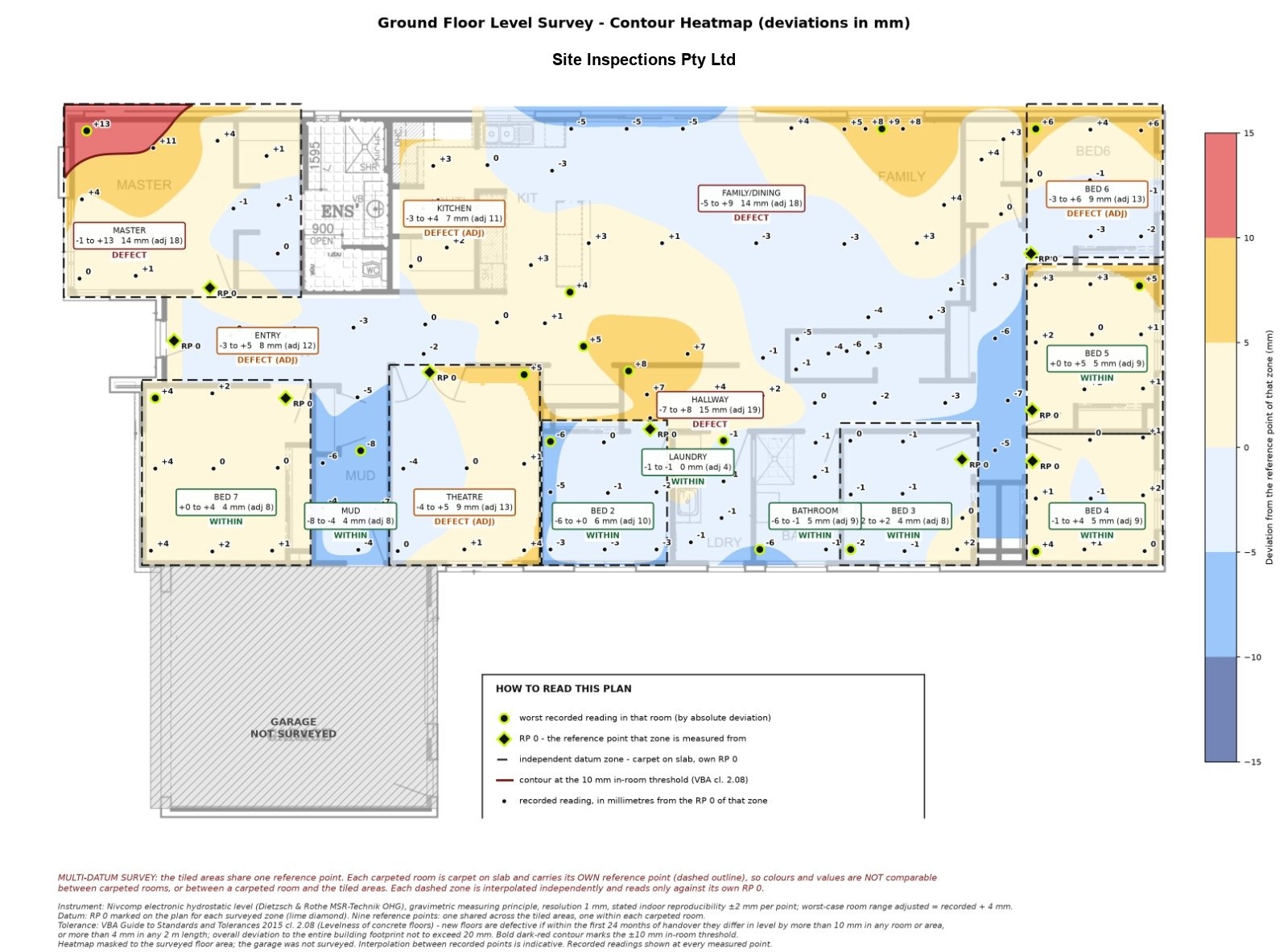
- Twenty four monthsLevel and crackingFloor level at 10 mm in any room, 4 mm over any 2 m and 20 mm across the building. Plasterboard and cornice cracking at 1 mm.
- Six yearsRoof plumbing, separate schemeRoof plumbing runs on the licensed plumber’s own insurance, not the builder’s, from the compliance certificate.
- No deadline at allThe expensive onesBouncy floors, roof leaks, window leaks, and water getting into a deck or balcony are not time barred by the Guide.
Victorian building work is assessed against the Guide to Standards and Tolerances. Which edition applies to your home depends on when your contract was signed:
- Contract signed or work commenced before 1 August 2026 – the 2015 Guide applies. That is almost every home currently in its warranty period.
- On or after 1 August 2026 – the 2026 Guide applies. It “does not apply retrospectively”.
Both editions measure their periods from completion, not from the day you collected the keys. Those can be different dates, and completion is usually the earlier one.
Three months, and this is the one that catches people
A door or window that binds, jams or will not operate as the manufacturer intended is assessed within three months of completion. Not two years. Three months.
The 2026 Guide puts it this way at clause 11.7:
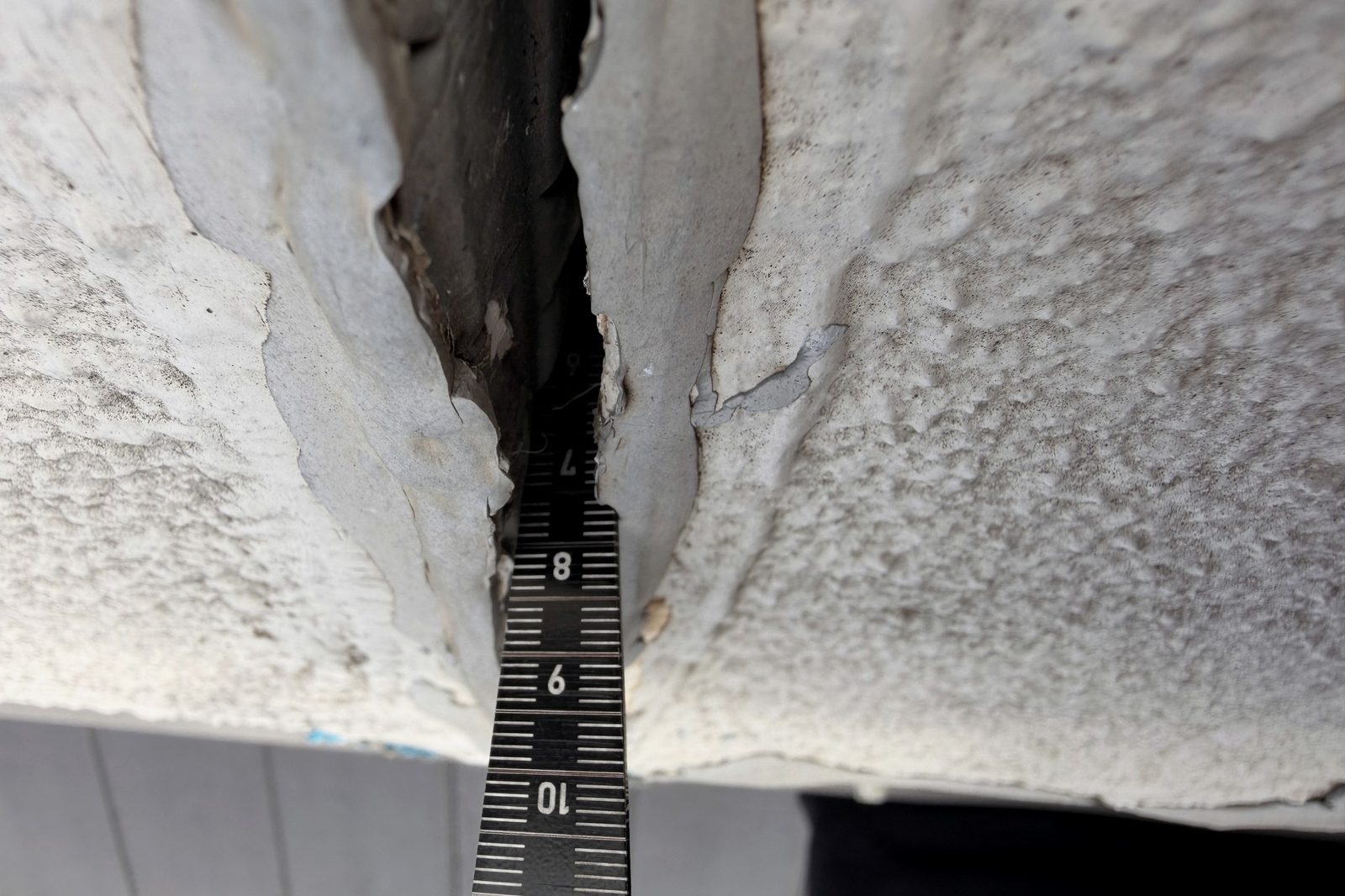
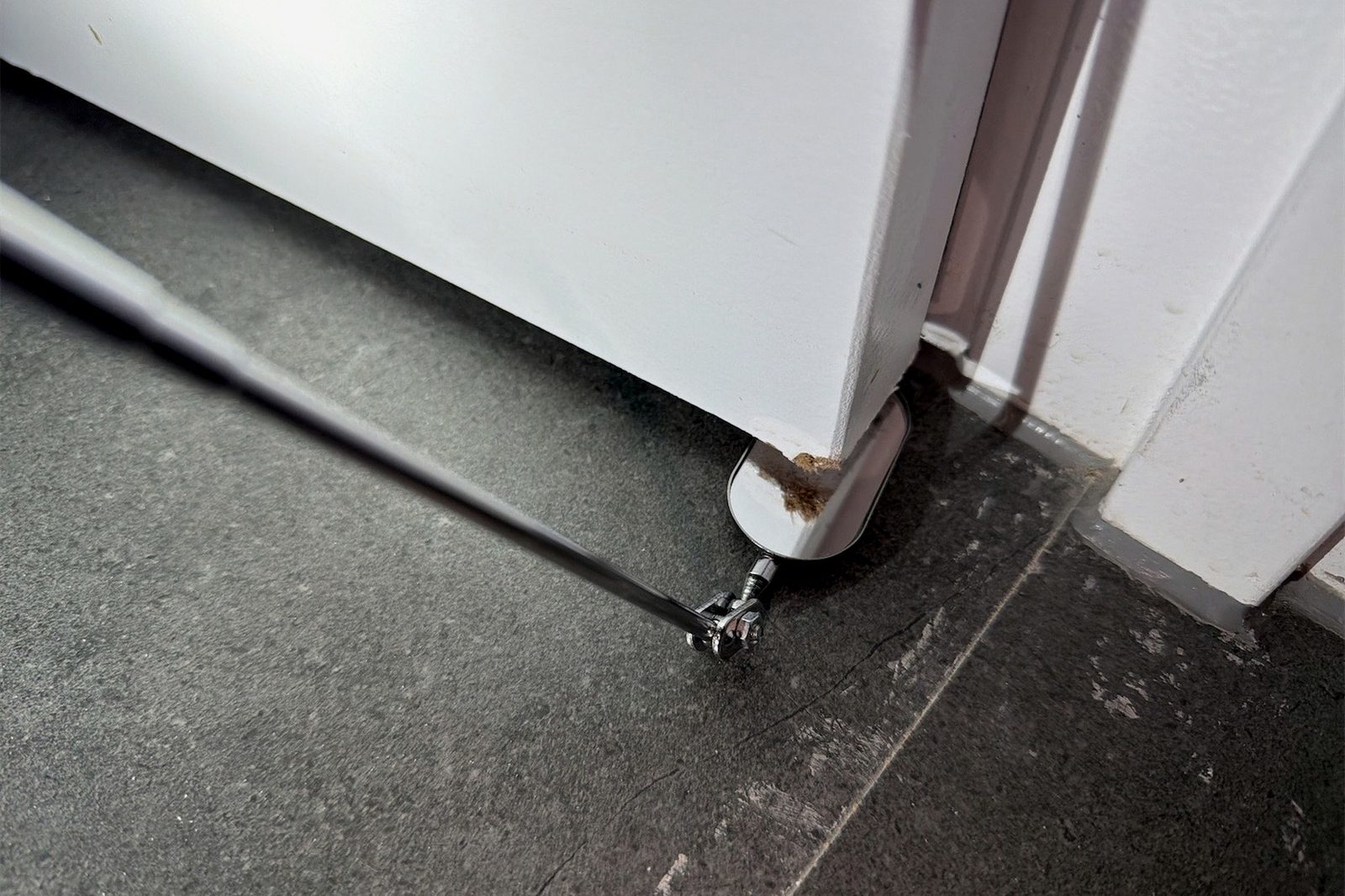
“The installation of doors and windows is not within tolerance if, within 3 months of completion, they bind or jam, or do not operate as intended by the manufacturer.”
The 2015 Guide says the same thing at clause 8.07, with one extra requirement: the binding had to be “as a result of the builder’s workmanship”. The newer edition drops that, which makes it easier to raise, not harder.
Most owners are still unpacking at three months. It is the shortest clock on this page and the one most often missed.
Twenty four months
Floor level is assessed within 24 months, and the numbers are identical in both editions: 10 mm in any room, 4 mm over any 2 m, and 20 mm across the whole building. Plasterboard and cornice cracking is 1 mm within the same 24 months.
Under the 2015 Guide, tiles that become cracked, pitted, chipped or loose are assessed for 24 months after handover where the builder’s workmanship caused it. The 2026 Guide removes that window entirely and assesses tiles at completion only.
So if your contract predates 1 August 2026, you hold a two year window on tiling that newer contracts do not get. It is worth using before it closes.
And some things have no deadline at all
This cuts the other way, and it is worth saying plainly because the rest of this page is about deadlines.
Floors that bounce carry no time limit in either edition. Neither do roof leaks, window leaks, or water getting into a deck or balcony. The short clocks are on operation and appearance. The defects that actually cost money to fix are not time barred by the Guide.
What we check once you are living in it
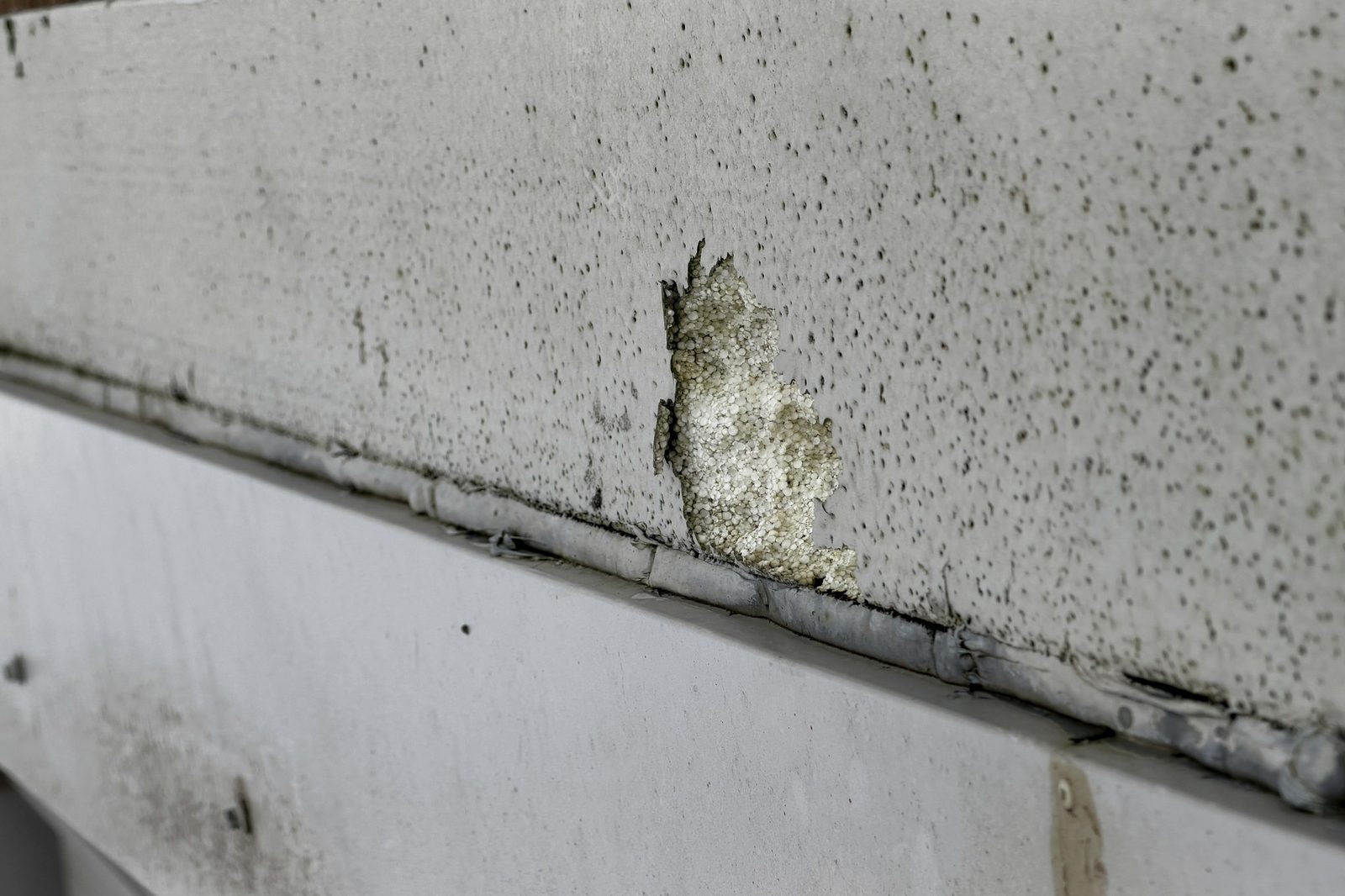
The defects that surface after occupation are a different set from handover day snags, because the building has been through weather and use.
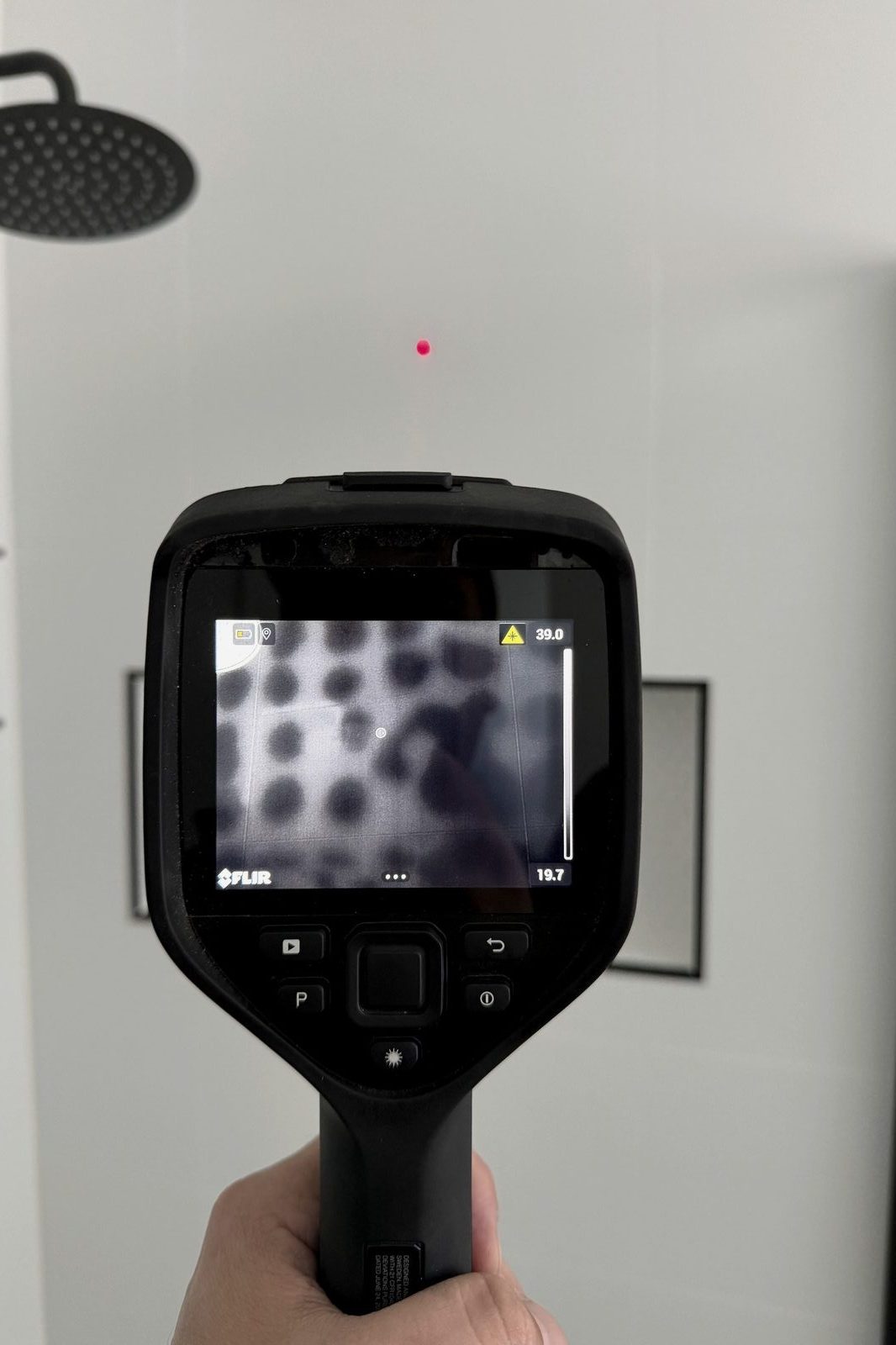
- Every wet area, under real use. Water escaping a shower does not announce itself. It swells the architrave and the door jamb first, months later, on the other side of the wall.
- Floor level, measured. A digital survey across the floor plate, room by room, against the 10 mm and 4 mm limits. Not a spirit level and an opinion.
- Cracking, measured with a gauge. One millimetre is a measurement, not an impression.
- Doors and windows through a season. Frames move. Which ones, how far, and whether it is within tolerance.
- The roof and its drainage. Box gutters, downpipes and flashings, including the parts you cannot see from the ground and would never think to look at.
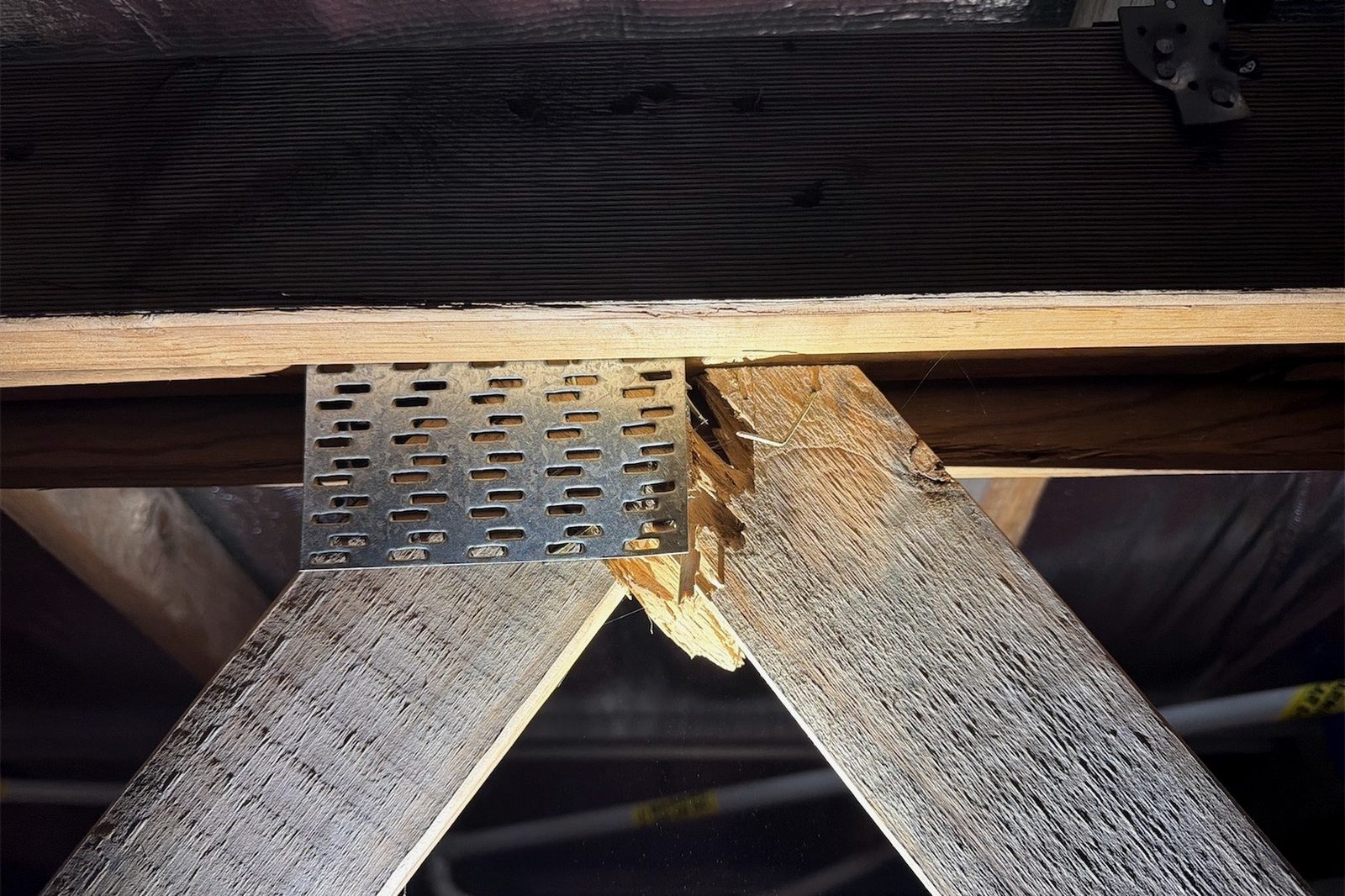
- The roof space. Trusses, plates and sarking. We have found cracked trusses with repair plates already over them, discovered only after handover.
If your builder has died, disappeared or gone under
Domestic Building Insurance may apply. The current instrument is the Domestic Building Insurance Ministerial Order published in Victoria Government Gazette No. S 95 on 28 February 2024, in force from 29 March 2024.
Its clause 8(3) allows the policy to apply only where “the builder dies, becomes insolvent or disappears”.
The periods are in clause 12, and the detail in them matters more than the headline:
- Two years for non structural defects
- Six years for everything else
Both run from “the earlier of” the completion date of the work or the date the building contract was terminated. If your contract ended because the builder collapsed, your clock may have started on that date, well before anything was finished. Owners counting six years from the day they moved in can be years out.
The Order also covers loss or damage occurring during that period. Damage that occurs after it is outside cover even where the cause was there from the beginning.
One more date worth knowing: contracts signed on or after 1 July 2026 fall under the new Home Warranty scheme rather than DBI, and cover does not transfer between them.
The roof has its own insurance clock, and almost nobody knows
Roof plumbing is not covered by the builder’s insurance. It sits under a separate scheme that licensed plumbers must carry, and it runs on a different clock from everything else on this page.
Clause 20(1)(a) of the Licensed Plumbers General Insurance Order 2002 requires cover for defects until:

“6 years after the plumber last issued a compliance certificate in relation to that work”
Where no compliance certificate was issued, it runs for six years after the plumber stopped carrying out the work. The cover survives the plumber: clause 20(2) keeps it running even if they stop being licensed, and even if they stop paying for the policy.
So the first question on any roof leak is one most owners have never been asked: was a compliance certificate issued, and do you have a copy? One is required where the work was valued at $750 or more. If a certificate exists, it dates your six years. If none was issued for work that needed one, that is itself worth knowing.
Where this cover stops, which matters as much as where it starts
We would rather tell you the limits now than have you rely on something that does not apply.
Membrane work is not covered. Regulation 25(2)(c) of the Plumbing Regulations 2018 excludes “any work on a membrane applied to a roof covering or roof flashing” from the definition of roofing work. A failed balcony or box gutter membrane, which is one of the most common leaks we are called to, falls outside this scheme entirely. It may still be a defect and it may still be covered elsewhere. It is simply not covered here.
Some roof coverings are excluded too. The same regulation carves out coverings of non-metallic tiles, timber, concrete, glass, bitumen or slate. Metal roofing, gutters, box gutters, downpipes and metal flashings are in. A tiled roof is not.
The amount is smaller than the headline. The five million dollar figure people quote is public liability. The limb that covers defective work is at least $50,000 for any one claim or series of claims relating to a compliance certificate.
This is insurance the plumber is required to carry, not a fund that pays owners on request. What it gives you is a clock, a document to ask for, and a reason not to wait.
When the builder says no
Most builders fix what is documented properly. The report arrives, the items are specific, each one is tied to the standard it fails, and the work gets done.
- The builder, in writingA dated document listing each defect against the clause it breaches. Not a phone call.
- The dispute service, earlyFree, and it is the step that can actually order the work fixed.
- Your building surveyorSection 35 gives them the power to inspect at any time. Worth asking, but likely closed once an occupancy permit exists, so do not wait on it.
- The insuranceIf the builder has died, disappeared or gone under, this is the route, and it has its own deadline.
When that does not happen, you are not out of options.
1. Give the report to the builder in writing. Not a phone call. A dated document listing each defect against the clause it breaches is a different conversation from a text message saying the shower leaks. Keep the dates.
2. Go to the dispute service, and go early. This is the step that can actually order the work fixed, and it is free. It is covered in the section below.
3. You can still ask your building surveyor to inspect. The Relevant Building Surveyor is named on your building permit with their registration number, so you have their details even if you have never spoken to them. Section 35 of the Building Act 1993 allows a surveyor to “cause building work… to be inspected at any time”, so asking them to look is asking them to use a power the Act gives them, not asking a favour.
But be realistic about what that produces after you have moved in. A direction to fix is the surveyor’s tool during construction. The regulator’s own practice note states it can only be issued before the occupancy permit or certificate of final inspection. If your home has an occupancy permit, that route is very likely closed, and an owner who spends six weeks writing letters to a surveyor about it has spent six weeks of a clock that is already running.
Ask the surveyor by all means, particularly if the work was never properly inspected at the mandatory stages. Just do not wait on it, and do not make it your only step.
What your building surveyor is actually bound by
Owners often assume the surveyor works for the builder. In Victoria the Code of Conduct for Building Surveyors, made under section 177A of the Building Act 1993 and in force since 1 January 2021, says otherwise. It is worth knowing the words, because a polite letter that quotes them lands differently from one that does not.
“Acting in the public interest requires putting the public interest ahead of private interests and the interests of clients, colleagues and other practitioners.”
“A building surveyor must act independently when providing building surveying services.”
And on the question of appearance rather than intent, which is the one an owner can raise without accusing anybody of anything:
“Avoid situations that a reasonable person may conclude has or could compromise your impartiality or professional judgement.”
There is also a provision most owners have never heard of, and it is in the Act itself rather than the Code. Section 78(1A):
“A builder who has entered into a major domestic building contract… must not appoint a private building surveyor on behalf of the owner of the land on which the domestic building work is to be carried out.”
Section 78(1B) adds that a building surveyor “must not accept an appointment referred to in subsection (1A)”.
So if your builder chose your surveyor and arranged the appointment on a major domestic building contract, that is a fair question to ask. Not an accusation. A question.
And while all of that is happening, find out whether the builder still exists. When a builder goes quiet it is worth checking rather than waiting. Look up whether the ABN has been cancelled, whether the company is still registered, and whether their building registration is still current. All three are free public searches.
This matters for a practical reason. If the builder has died, become insolvent or disappeared, that is the trigger for a Domestic Building Insurance claim, and there are time limits on it. An owner who spends eight months waiting for a builder to call back can find the answer was available on day one.
The free dispute service, and the name confusion around it
Separately from the enforcement route above, Victoria runs a free conciliation service for domestic building disputes. It is worth knowing three things about it.
It is free, and it can order the work fixed. If conciliation does not resolve matters, the chief dispute resolution officer can issue a binding dispute resolution order. Section 49B(1) of the Domestic Building Contracts Act 1995 lets that order require a builder to rectify defective work, rectify damage caused by the work, or complete the work. Where the work is found to be so defective that it would not be appropriate to let the original builder back on site, section 49C(1)(c) allows an order that the builder pay the reasonable cost of another builder finishing the job.
It will assess the building for you, free. The service can appoint a statutory assessor, and under section 48T the assessor’s report is admissible in evidence.
You generally cannot skip it. For most domestic building disputes it is the compulsory step before a tribunal will hear the matter.
Now the confusing part, and it catches people. This service used to be called Domestic Building Dispute Resolution Victoria, or DBDRV. Since 1 July 2025 it has sat inside the regulator, and the old website now redirects to the Building and Plumbing Commission. The statutory body still exists in the Act, and orders are still issued by the chief dispute resolution officer, but the front door has moved.
So if you read one page telling you to contact DBDRV and another telling you to contact the Building and Plumbing Commission, they are the same step. Start at the Commission.
These processes run on documents. Nobody acts on “the floor feels wrong”. They act on a report that says which room, by how many millimetres, against which clause, on what date.
The clock behind all of it
Section 134 of the Building Act 1993 sets a ten year limit on building actions, running from the occupancy permit or certificate of final inspection. Everything above happens inside that.
That is why the order of these steps matters more than it looks. Every route that turns out to be closed still costs you months, and nothing you do stops the ten years running. Making a complaint does not pause it. Waiting for a builder to return a call does not pause it.
Two things worth knowing before you push a route that sounds appealing:
- A complaint about your surveyor does not fix your house. It goes to their registration. It may well be the right thing to do, and sometimes it is the only way a pattern gets noticed. It is not a repair.
- Be careful what you ask a regulator to order. A building order can be directed at the owner, requiring you to carry out the work, and it can prohibit occupation. Owners have gone looking for help and come back with an obligation. Take advice before you go down that path.
This is not theoretical, and the sequence above is the one that worked
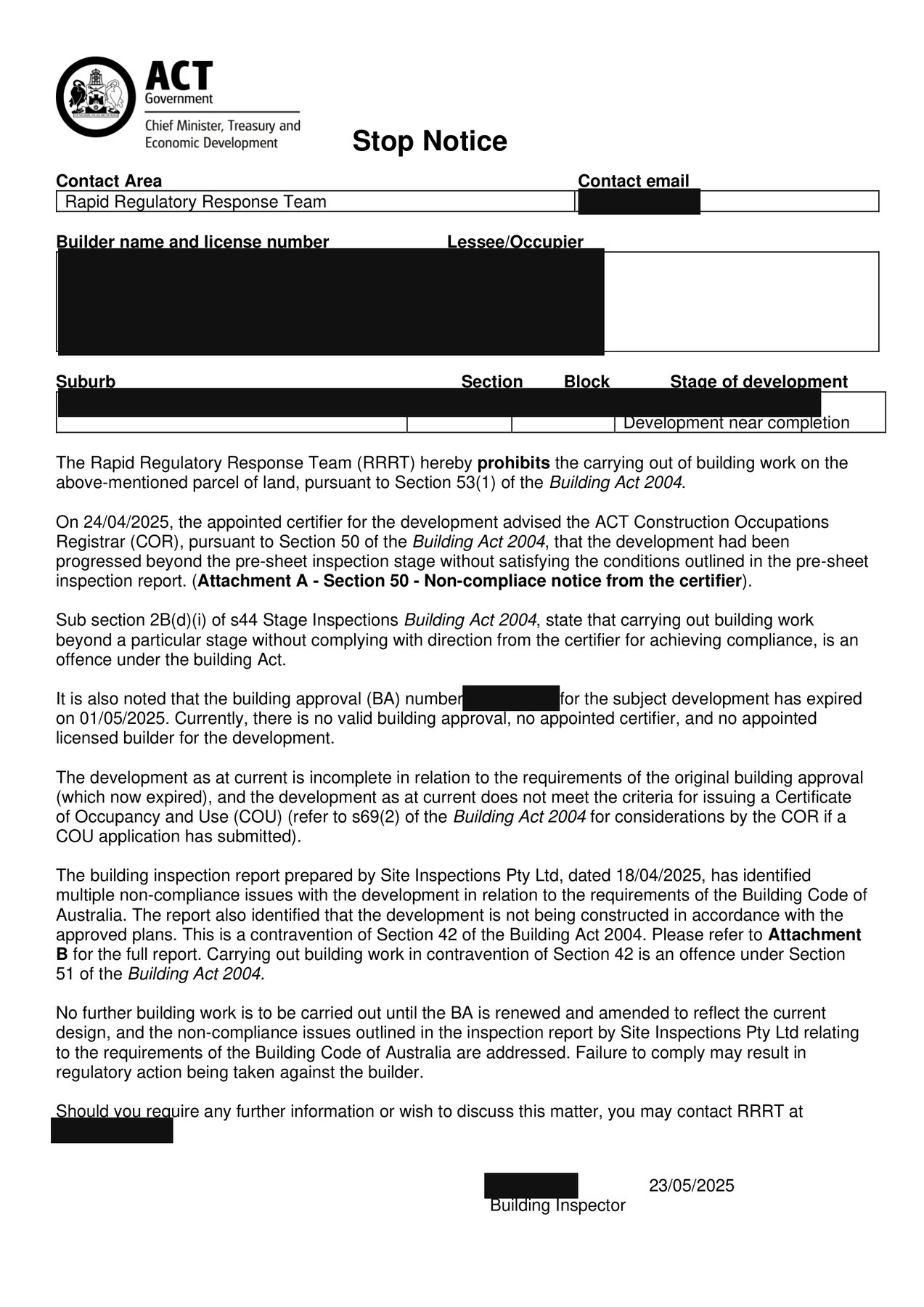
On 23 May 2025 the ACT Government’s Rapid Regulatory Response Team issued a Stop Notice under section 53(1) of the Building Act 2004 (ACT), prohibiting further building work on a development. The notice named this consultancy in its operative words. Work could not resume until, in the notice’s own language:
“the non-compliance issues outlined in the inspection report by Site Inspections Pty Ltd relating to the requirements of the Building Code of Australia are addressed.”
Our report was Attachment B to that notice.
That matter followed exactly the sequence set out above. The certifier acted first, notifying the registrar that the work had progressed beyond an inspection stage without meeting the conditions. The regulator followed, and made rectification of our findings a condition of resuming work. Surveyor first, regulator second.
In Victoria, four separate Directions to Fix under section 37F(1) have been issued on builds we inspected between 2024 and 2025.
A regulator acting on a report is a matter of record, and it has happened on our work more than once. It does not mean it will happen on yours. Every matter turns on its own facts, and no inspector can promise a regulator will act. What an independent report does is put the evidence in a form a regulator, a dispute service or an insurer can use. Whether they use it is their decision.
Which inspection do I actually need?
Three different moments, and the right one depends on where you are:
- You have not taken the keys yet. You still have the final payment, which is the strongest position you will ever be in. That is a handover inspection.
- The builder says the work is finished and you are not sure. That is a practical completion inspection.
- You have moved in and things are appearing. That is this page.
If you are not sure which describes you, say so when you enquire and we will tell you.
Questions we get asked
Is it too late? Often not. The short clocks are on doors, windows and appearance. Leaks, bouncing floors and structural items are not time barred by the Guide, and the insurance periods run to six years for anything other than non structural defects. Send the address and what is happening and we will tell you where you stand.
Do I need to be there? No. Most of our work is documented and reported without the owner present, which matters if you are interstate or cannot take the day off.
How long until the report? Usually within 24 hours of the inspection. A complex matter takes longer, and we will tell you up front.
What does it cost? Every job is quoted, because no two are the same. Send the address and what you are worried about and you will have a figure back in under 24 hours.
Law stated as at 17 August 2026. Victorian provisions only; New South Wales building certification is being restructured and this page will be updated when that settles. Site Inspections has no current engagement in any matter referred to on this page. We inspect, document and report; we do not carry out rectification work, and we have no interest in the outcome of any claim.

Get your defects documented while the clocks are still running
Send an enquiry and tell us what you are seeing. We will ask when you took possession, what the builder has been told already, and for any photographs you have, then quote the inspection. Every job is quoted, because a two bedroom unit and a double storey house are not the same inspection.
We don’t just do inspections. We investigate.