
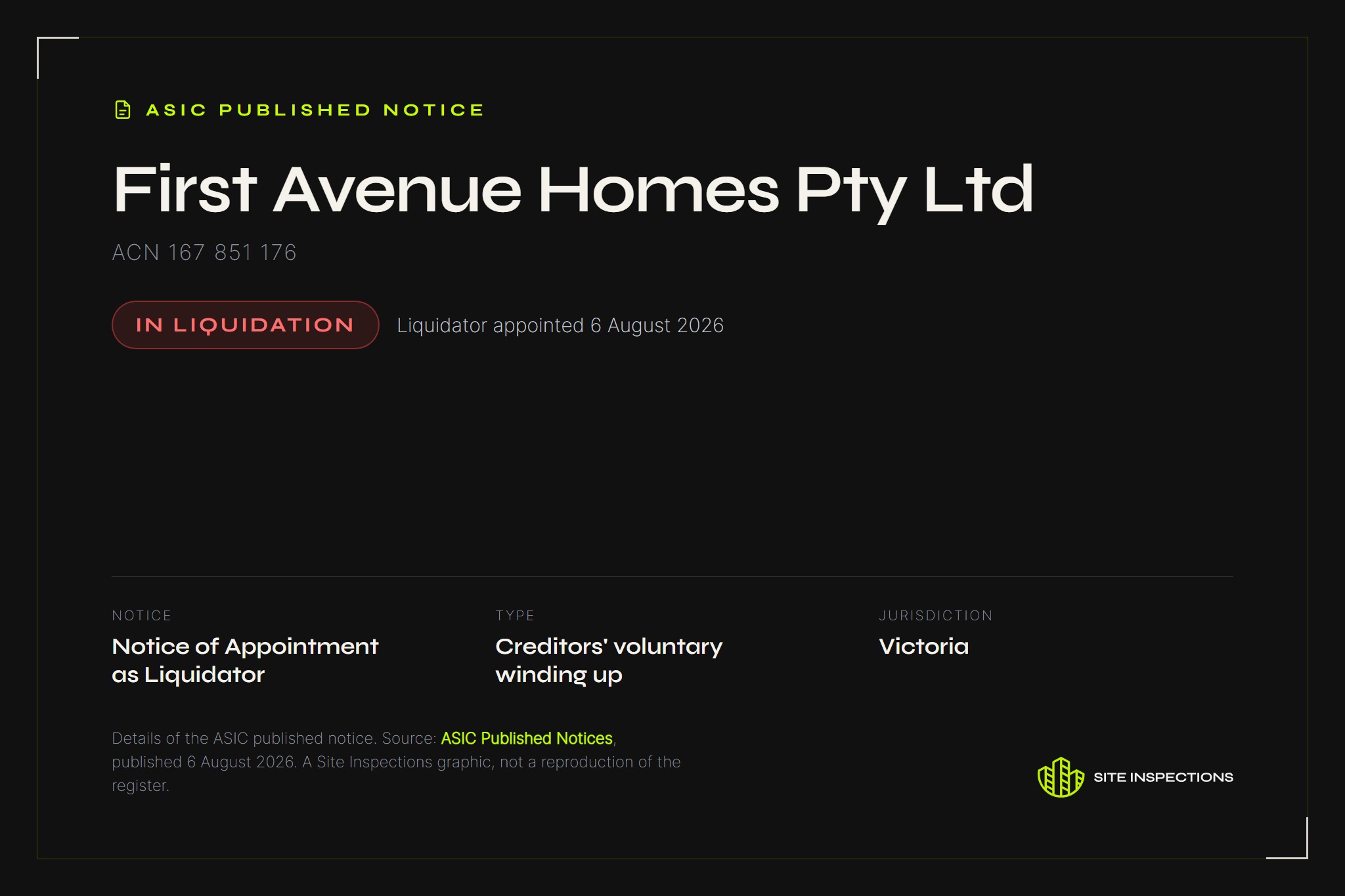
A liquidator was appointed to First Avenue Homes Pty Ltd on 6 August 2026. Builder insolvency is one of the few events that opens a Domestic Building Insurance claim in Victoria, and the policy wording measures the deadline from when an owner became aware, or ought reasonably to have become aware. This explains what the cover does, what it does not do, and what we documented on one of this builder's completed homes.
01What has happened
The liquidation is a published fact. This section states it and nothing more.
On 6 August 2026, a liquidator was appointed to First Avenue Homes Pty Ltd, ACN 167 851 176, in a creditors' voluntary winding up. The appointment appears in ASIC's published insolvency notices.
In practical terms, a company in liquidation is being wound up and is not in a position to return to site to complete or rectify work. For an owner part way through a build, or living in a recently completed home with defects they have been waiting to have fixed, that is the moment the ordinary remedy disappears. It is also the precise event that domestic building insurance exists to answer.
02Why insolvency matters
Domestic Building Insurance is not a general warranty. It answers a short list of events, and insolvency is one of them.
Most Victorian domestic building work above the prescribed threshold must carry Domestic Building Insurance. For homes built under the scheme in place before July 2026, that cover was provided by the Victorian Managed Insurance Authority, which the policy describes as a designated insurer under the Building Act 1993.
The distinction that catches people out is this. The policy does not respond simply because work is defective. It responds when the builder cannot be made to put the work right, and the policy wording lists exactly when that is.
"Domestic Building Insurance protects you. This policy covers loss or damage resulting from the non-completion of the work or breach of statutory warranty because of: death; or disappearance; or insolvency of the builder or speculative builder."
Defect cover carries one further condition. It applies where the owner cannot recover from the builder, and insolvency is what satisfies that condition. Whether an item is treated as a defect at all, rather than as work that was simply never finished, is a separate decision that changes what a claim can pay. We have set out what decides a domestic building insurance claim and why that classification matters.
Domestic Building Insurance also assumes the person who did the work was a registered builder carrying the required cover. Where somebody was posing as a registered builder, that assumption fails before the policy is ever reached, and the homeowner is left with a different problem entirely.
"the following loss or damage but only if you cannot recover compensation from the builder or speculative builder, or have the builder or speculative builder rectify the loss or damage, because of the insolvency, death or disappearance of the builder… loss or damage arising from work that is defective"
03What the cover does, and what it does not
The headline numbers, and the limits that sit behind them.
A claim can cover both incomplete work and defective work once the trigger is met, along with some associated costs such as alternative accommodation, removal and storage for a limited period, and loss of deposit.
The duration is where most summaries go wrong, and it is the same trap as when warranty cover expires. It is not one flat six year period.
Non-structural: "…ending 2 years after the completion of the work or the date of termination of the building contract, whichever is the earlier."
All other causes: "…ending 6 years after the completion of the work or the date of termination of the building contract, whichever is the earlier."
04The 180 day clause, in full
This is the single most consequential sentence in the policy for an affected owner, and most summaries drop half of it.
The usual shorthand is that you have 180 days from when you find out. The wording asks for something more demanding than that.
"We will refuse any claim by you unless you notify us in writing of the death, disappearance or insolvency of the builder… within 180 days of you becoming aware of that event or happening or when you might reasonably be expected to have become aware of that event or happening (whichever is the earlier)."
The tail is the part that matters. The period can be measured not only from the day an owner actually learned of the insolvency, but from the day they might reasonably have been expected to learn of it, whichever comes first. A liquidation is a public, published event. An owner who waits because nobody has formally written to them is relying on the more generous of two readings, and the clause takes the earlier one.
There is a related provision worth knowing. Under clause 53, notifying one defect is treated as notice of every defect directly or indirectly related to it. That is a strong argument for putting a complete, documented schedule in at the time of notification rather than sending items through one at a time.
05What we documented on one completed home
A single property, inspected in August 2025 for the homeowner who engaged us. These are our own documented observations on that one home, each measured against a named standard. They have not been tested in any proceeding, they are not findings of any court or regulator, and they are not a statement about any other home.
Four findings stand out, and they are not cosmetic.
An external wall with the frame visible from outside
On a boundary wall that the stamped plans required to be fire rated, we observed the internal framing visible from the exterior, together with water penetration through the wall assembly.
"External boundary wall… visible internal framing from exterior and water penetration through wall assembly. Plans require wing wall to achieve FRL 60/60/60 extending at least the same height as the opening."
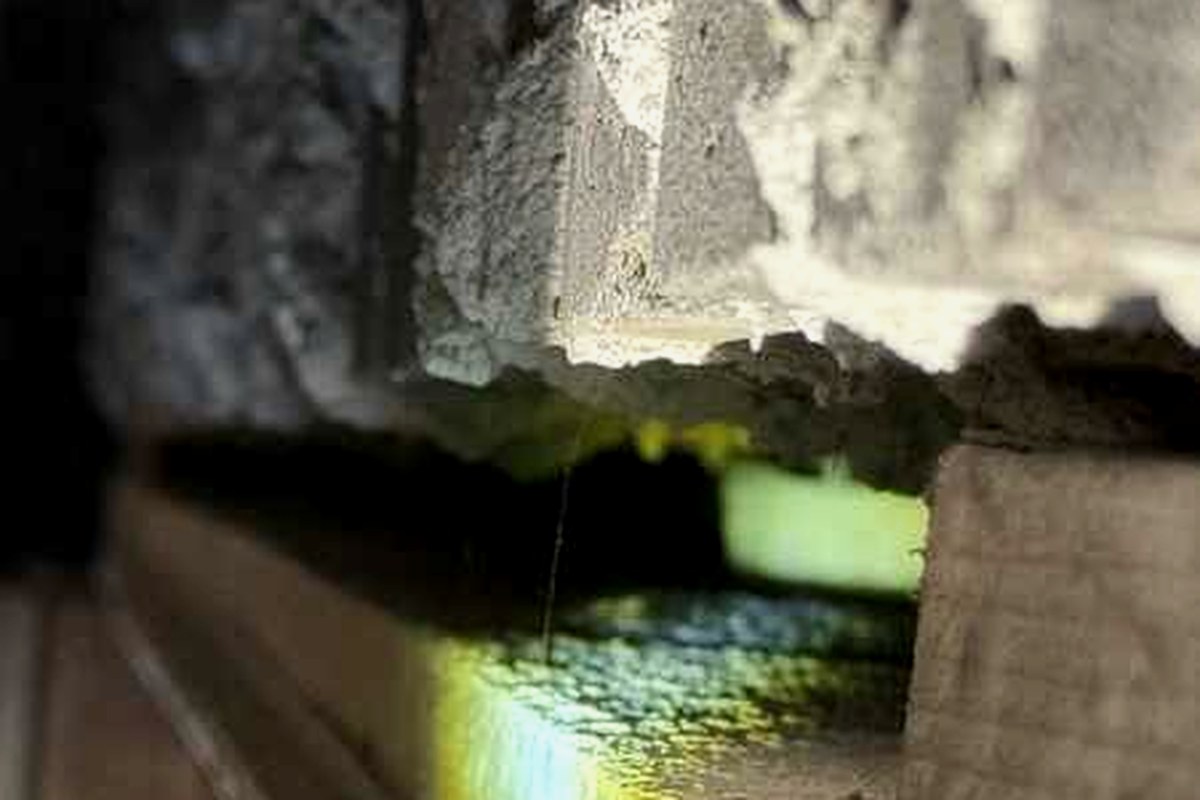 Item 5.1.1. The void beneath the boundary wall. Site Inspections photograph, August 2025.
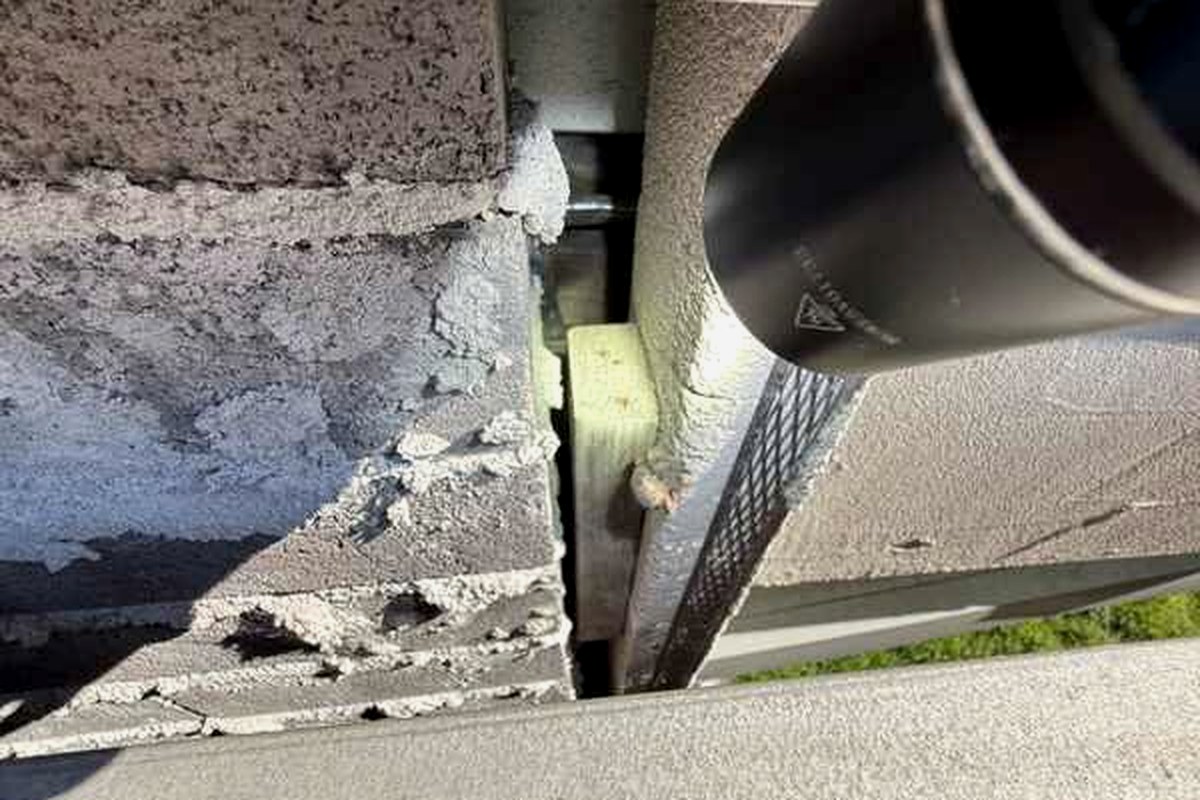 Item 5.1.1. The gap at the blockwork junction, with framing exposed to the weather. Site Inspections photograph, August 2025.
That single wall engages three separate requirements at once. Fire separation between dwellings under the National Construction Code, weatherproofing under the same code, and compliance with the approved permit documents under the Building Act 1993. The Guide to Standards and Tolerances puts the workmanship point plainly: external walls must prevent water penetration and be finished in a workmanlike manner with no visible framing.
A screw through the waterproofing membrane
In a wet area, a door stop had been fixed with a screw driven through the waterproofing membrane, in a shower area with no waterstop separating it from the rest of the room.
"This penetration, combined with the absence of a waterstop separating the shower area from the rest of the wet area, poses a significant risk of water damage… water migration under the tiles."
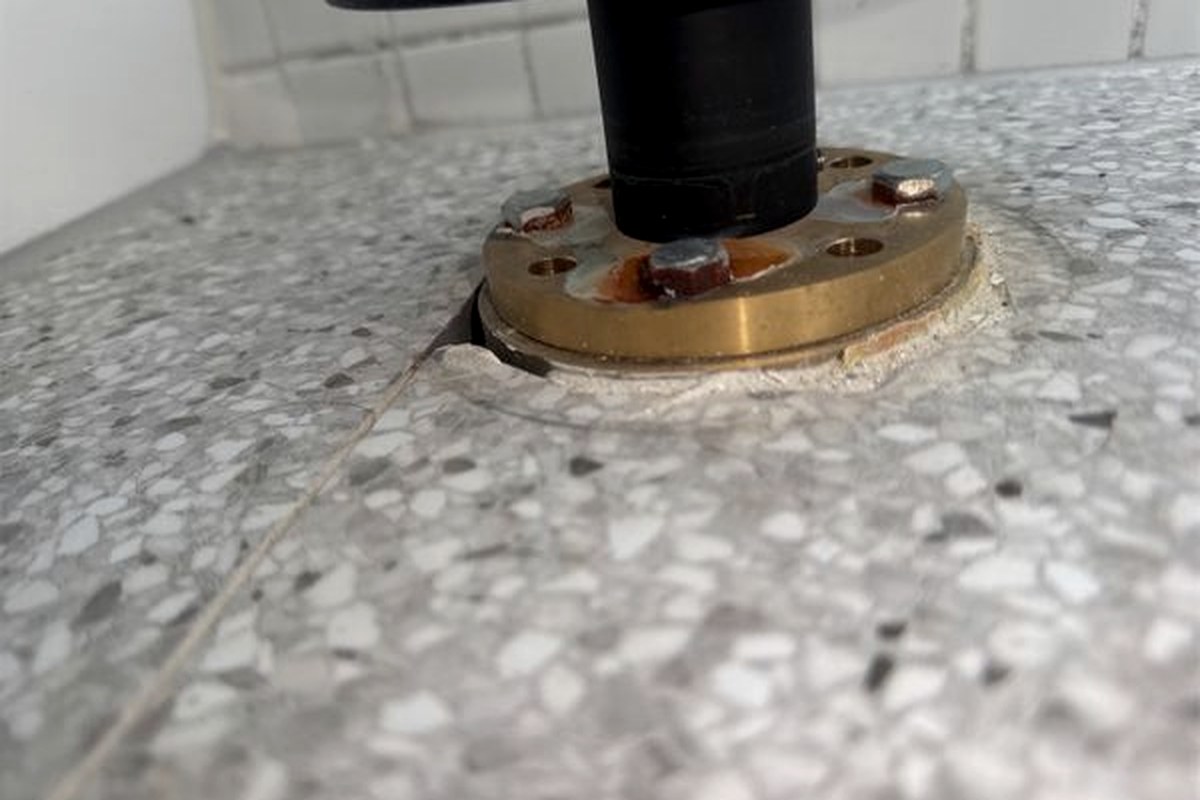 Item 16.10.2. The door stop fixing, with a crack running away from it across the floor. Site Inspections photograph, August 2025.
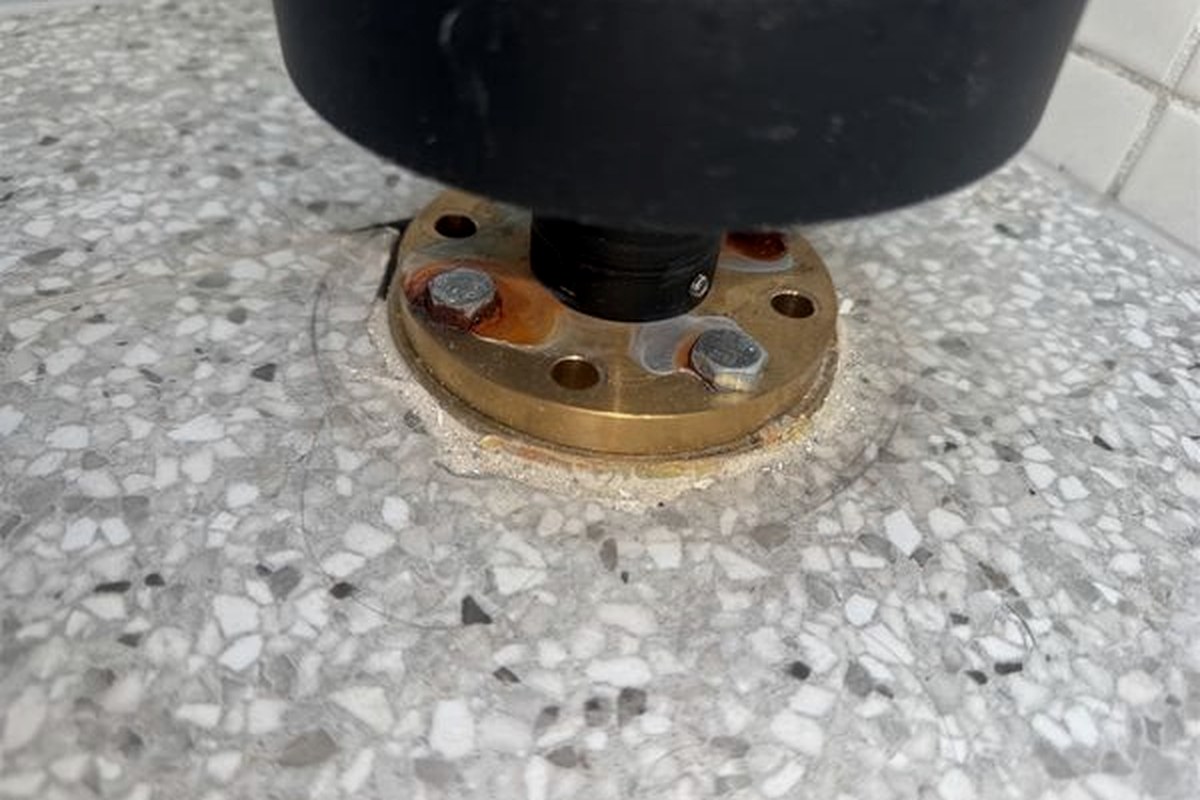 Item 16.10.2. Staining at the screw heads. Site Inspections photograph, August 2025.
Stone fixed with dabs of the wrong adhesive
In both the bathroom and the ensuite, stone had been spot bonded using cementitious adhesive. The standard permits spot bonding only with reaction resin adhesives, and in wet areas the required adhesive contact coverage is 90 per cent.
"Spot bonding with cementitious adhesive is not an acceptable method, as it creates voids behind the stone, affecting the mechanical performance of the installation."
Spot bonding is not visible once the stone is on the wall, which is why it so often goes unrecorded. We surveyed it with a thermal imaging camera: the adhesive dabs hold heat differently from the voids around them, so the pattern of contact shows up as bright spots against a cooler field.
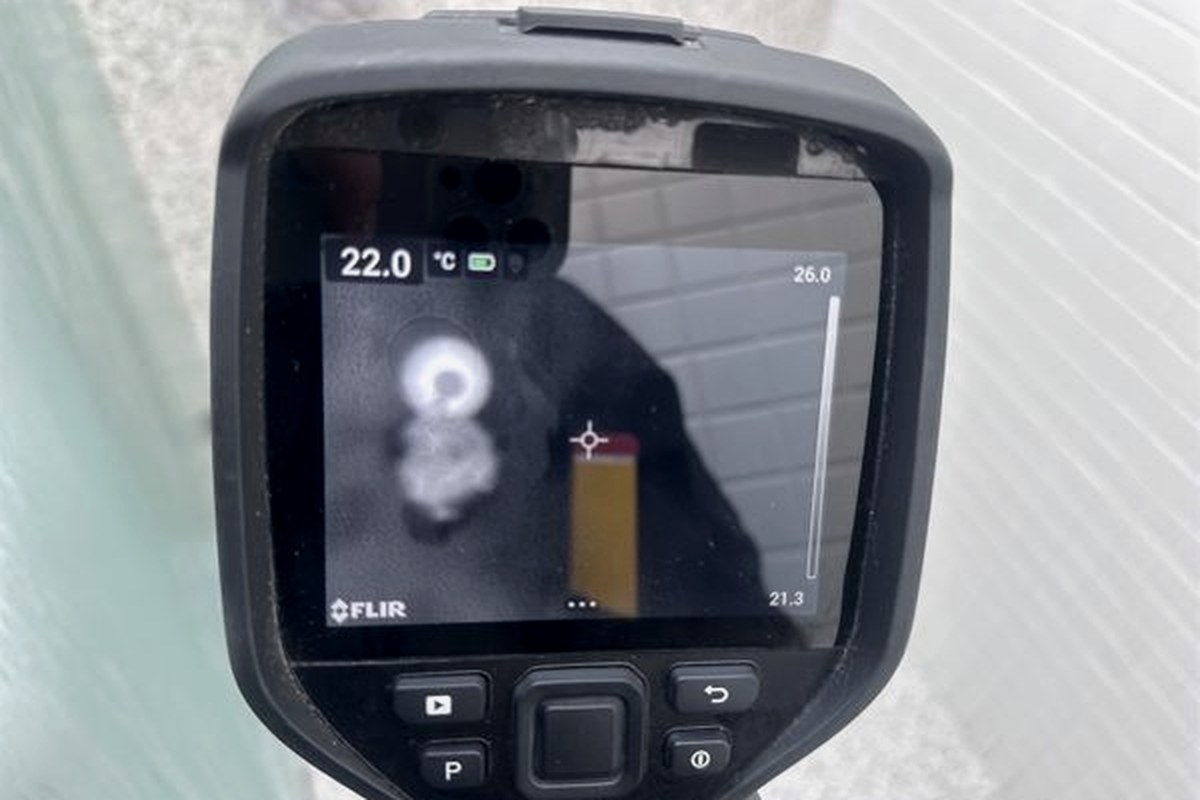 Items 15.2.2 and 16.2.2. Thermal survey of the stone. Site Inspections photograph, August 2025.
 Items 15.2.2 and 16.2.2. A second reading on the same surface. Site Inspections photograph, August 2025.
Safety glass that cannot be verified
The installed safety glass carried no marking at all. Under AS 1288, each panel must be marked with the manufacturer, the type of safety glass, the standard it was tested to, the grade of test classification and the thickness.
"It is not possible to determine whether the installed glass meets the required safety standards, which could have implications in case of accidental impact or other emergency situations."
The remainder of the report records the findings below, among others.
06Which of your defects are still claimable
The six year and two year split decides this, and the insurer publishes its own list of what falls on each side.
The consumer guidance for the scheme lists structural cover as including footings, floors, roofs, external walls and load bearing internal walls, columns and beams, leaking balconies, defective or non-existent flashings, defective or non-existent waterproofing to external walls or roof, and windows and doors in external walls. Non-structural items include caulking, brickwork, internal doors and non load bearing internal walls, along with fittings such as handles, locks and taps.
Set against that list, the findings above fall out in a way that matters a great deal to an owner deciding what to do.
The floor row is the one to look at twice, because it shows how the same observation can fall either side of the line. A floor that is simply out of level is a finish tolerance, and carries the two year window, which is why a post handover inspection matters so much in the first two years. The same floor carries the six year window if the unevenness is attributable to movement in the slab or footings and there is evidence of structural movement to support it. Cracking that follows a pattern, doors and windows going out of square, separation at cornices and skirtings: those are the signs that turn a surface complaint into a structural one.
Our report on this home did not attribute the floor variation to slab movement. It recommended a structural engineer assess the irregularities and advise on cause. Until that assessment is done, the item cannot honestly be placed in either category, and which category it lands in decides whether it is claimable at all.
07What the policy says
Extracts from the VMIA Domestic Building Insurance policy wording, edition QM2948-0711, effective 1 July 2011. Later editions renumber the clauses and change the monetary limits: this edition's own clause 37 caps cover at $200,000, which was lifted to $300,000 for policies issued after 1 July 2014. The extracts below are quoted for the structure and language of the cover, not as the terms governing any particular home. Check every clause and every figure against the edition named on your own certificate of insurance.
"The builder or speculative builder takes out this policy, but the beneficiary is you."
"You are the person covered under this policy. We do not cover anyone except you."
"the person on whose behalf the work is done or is to be done and who is named on the certificate of insurance as the owner and any successor in title to that person."
"the cost to you of alternative accommodation, removal and storage costs reasonably and necessarily incurred… We will not pay for accommodation or storage costs for any period… that exceeds 60 days… and your loss of a deposit or progress payment (or part of it) under the building contract."
"Our liability under clause 32(a) is limited to 20% of the building contract price (accounting for any adjustment of the building contract price as a result of an agreed variation to the work)."
"any defect in a structural element of the building that is attributable to defective design, defective or faulty workmanship or defective materials… and that… prevents, or is likely to prevent, the continued practical use of the building or any part of the building… or results in, or is likely to result in… physical damage to the building or any part of the building."
"(a) the date of issue of the occupancy permit in respect of the building… (b) if an occupancy permit is not issued, the date of issue… of a certificate of final inspection of the work. (c) in any other case, the date of practical completion of the work."
"If you notify us of a structural defect or other defect, you are taken to have given notice of every defect to which the defect is directly or indirectly related."
"We will not either refuse to pay a claim under this policy or reduce any liability under this policy on the ground that the builder… (b) failed to comply with the duty of disclosure… (d) failed to comply with a provision or requirement of the policy… or (f) failed to pay the policy premium."
"each of the following warranties implied by section 8 of the Domestic Building Contracts Act: (a) that the work will be performed in a proper and workmanlike manner and in accordance with the plans and specifications set out in the building contract."
"(b) the first $500 for claims made between 1 and 3 years after completion… (c) the first $750… between 3 and 5 years… (d) the first $1000 for claims made later than 5 years after completion."
"no amount is payable by you… for loss or damage arising… from non-completion of the work."
The scheme also publishes what it does not cover. That list includes vandalism or theft, fair wear and tear, failure to maintain, liquidated damages, legal fees relating to a dispute between an owner and their builder, loss of rental income, travel expenses, and consequential loss of any kind. Driveways, retaining structures, landscaping, fencing and paving sit outside the cover as well.
08What to do now
If your home was being built, or was completed, by First Avenue Homes.
You do not need an inspection report to notify. Notification is free, and the clause that decides whether a claim survives is the 180 day one. Notify first, then document. A defects report strengthens and quantifies a claim and makes it assessable; it is not a precondition to lodging one, and nothing in this article should be read as saying otherwise.
A claim of this kind is decided on documentation. What an assessor can act on is a defect that has been located, measured, photographed and tied to the clause or standard it engages, with the structural items separated from the non-structural ones so the right window is claimed against each.
Site Inspections prepares the defects report that a Domestic Building Insurance claim is built on. Every item measured, photographed and referenced to the clause or standard it engages, in the format an insurer and a rectifying builder can act on. If your builder was First Avenue Homes and your home is incomplete or you suspect defects, get a defects report for your insurance claim while the notification window is still open.
09Sources
Every claim in this article is drawn from one of the documents below.
Our Blog
YOUR GO-TO RESOURCE HUB
Whether you’re on the hunt or have already settled in, we’ll arm you with the know-how and confidence to keep your home safe and compliant. With our guidance, you can make informed decisions and steer clear of common pitfalls.